
How Long Can You Leave an EV Parked Without Battery Problems

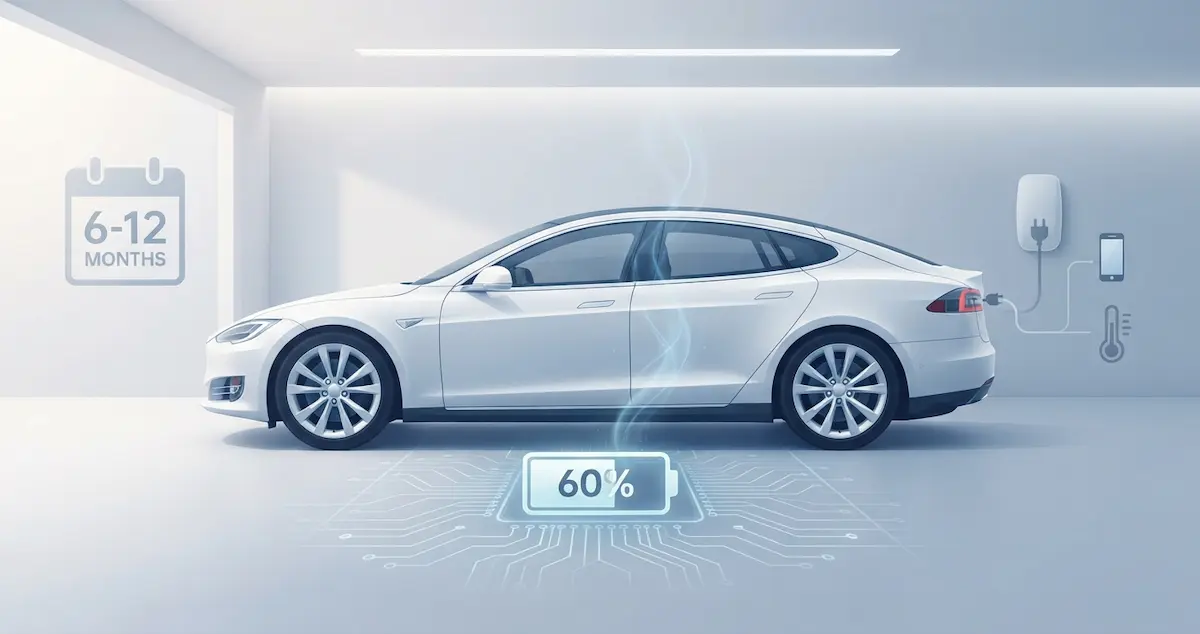
You need to park your EV for an extended period — vacation, deployment, seasonal storage, or travel — and you want to know how long you can leave it before the battery becomes a problem. This guide provides clear time limits for different situations and explains exactly how to prepare an EV for extended parking to protect both battery health and operational readiness.
Quick Answer
With proper preparation — 50–60% charge, features disabled, plugged in if possible — an EV can be left parked for 6–12 months without significant battery problems. Without preparation (active features, extreme temperatures, or incorrect SOC), 2–4 weeks without attention can lead to operational issues and potential battery stress. The battery itself is designed for extended storage; the challenge is managing the connected systems that consume power even when the car is idle.
Extended Parking Time Limits by Scenario
| Scenario | Safe Duration | Notes |
|---|---|---|
| Plugged in, all features normal | Indefinitely | Charger maintains battery; no time limit |
| Unplugged, 60% charge, features minimized, mild climate | 6–12 months | 0.3–0.5% drain/day × 180 days = 54–90% used |
| Unplugged, 60% charge, Sentry Mode active | 3–5 days | Sentry drains 5–10%/day; depletes in under a week |
| Unplugged, 20% charge, features normal | 3–4 weeks | 1–2% drain/day hits critically low in 10–20 days |
| Unplugged, extreme heat, 80% charge | 1–2 months with monitoring | Heat increases drain; check remotely every 2 weeks |
| Unplugged, extreme cold, 60% charge | 2–3 months | Cold slows chemistry; lower drain but battery warming may run |
What Happens to the Battery During Long-Term Parking
Self-discharge — very slow
Lithium-ion batteries self-discharge at approximately 1–3% per month in the absence of any connected systems. For an EV that’s truly powered off (which is not possible on modern connected EVs), self-discharge alone would take over a year to reduce a full battery to a critically low level. This is not the primary concern for EV storage.
Connected system drain — the real clock
The real limit on EV storage time is connected system drain — the BMS, cellular modem, GPS, and security systems that can’t be fully powered down without disabling the car’s connected features. These draw 0.5–2% per day in normal operation. Without mitigation, a fully charged battery depletes to critical levels in 50–100 days at the high end of this range.
Battery chemistry during storage — calendar aging
All lithium batteries age gradually even without cycling — this is called calendar aging. Calendar aging is accelerated by high temperature and high state of charge. Storing at 100% SOC in a hot garage for 6 months causes more calendar aging than storing at 50% SOC in a cool garage for the same period. Mid-range SOC (40–60%) and cool, stable temperatures are ideal conditions for minimizing calendar aging during long storage.
How to Prepare an EV for Extended Parking
If you can keep it plugged in — the best option
Leaving the EV connected to a Level 1 or Level 2 charger during storage eliminates standby drain as a concern. The charger continuously maintains the battery at its set charge limit. You can set the charge limit to 50–60% for long-term health. The car can stay plugged in for months or even years without battery damage — the BMS manages charging to prevent overcharging.
- Set charge limit to 50–60% (not 100% for storage)
- Leave plugged in to Level 1 or Level 2
- Disable Sentry Mode / Guard Mode (it would draw power even while plugged in, and the charging may not fully offset Sentry drain at Level 1)
- Check the app every 2–4 weeks to confirm the car remains charging normally
If you cannot keep it plugged in — minimize drain and monitor
- Charge to 50–60% SOC before leaving — never park for extended periods at 100% or below 20%
- Disable Sentry Mode / Guard Mode — the single highest-impact feature to disable for unplugged storage.
- Disable Scheduled Departure — prevents repeated preconditioning events
- Enable sleep mode in all third-party apps — reduces app polling drain
- Remove OBD2 adapters
- Park in a garage or shaded area — stable, cool temperature reduces thermal management cycling
- Check SOC remotely every 2 weeks via companion app — if SOC drops to 20%, recharge remotely or return to charge
The 20% Rule — Minimum SOC for EV Storage
Monitor remotely and intervene (return to charge or use the app’s remote charging if you’re near a plugged-in car) when SOC reaches 20%. Below 20%, some EVs begin implementing additional protective measures that can make the car harder to start or charge when you return. Below 10%, the BMS shuts down all non-essential systems and the car enters a deep protection state. Staying above 20% throughout storage keeps the car in a recoverable, operationally ready state.
Returning to a Long-Parked EV — What to Check
- Check SOC before any action — if below 15%, connect to a charger before starting the car
- Charge to 80% before the first drive to allow BMS to assess the pack in a charged state
- Test the 12V battery — extended storage can deplete or stress the 12V auxiliary battery
- Run a BMS recalibration cycle if range seems off: drive to 15%, charge to 100%, hold for 1 hour, drive normally
- Check for pending software updates — updates may have queued during storage
- Inspect the charge port for dust, debris, or oxidation if stored in a dusty environment
Brand-Specific Extended Parking Notes
- Tesla: Exclude the storage location from Sentry Mode — most critical step. Tesla recommends 50% charge for extended storage in owner documentation. Tesla’s app shows SOC remotely so you can monitor without being present.
- Nissan Leaf: No remote SOC check without an active Nissan Connect subscription. Leave at 40–50% charge with LeafSpy reading confirmed before leaving. Reconnect and check SOC in person every month for storage beyond 30 days.
- Chevy Bolt: Low standby drain (0.5–1%/day) makes the Bolt one of the best EVs for unplugged storage. 60% charge, Scheduled Departure disabled, monthly check via myChevrolet app.
- Rivian: Disable Guard Mode. Rivian app provides remote SOC monitoring. 50–60% charge for storage.
- All 800V EVs (Ioniq 5, EV6, Taycan, etc.): Standard storage recommendations apply. The 800V architecture doesn’t affect storage behavior — drain rates are similar to 400V vehicles with equivalent features.
Conclusion
An EV can be left parked indefinitely if plugged in, and for 6–12 months if unplugged with proper preparation. The limit isn’t battery chemistry — it’s connected system drain depleting the battery over time. Prepare for long-term parking by charging to 50–60%, disabling Sentry Mode and Scheduled Departure, enabling app sleep modes, removing OBD2 adapters, and parking in a stable-temperature environment. Monitor SOC remotely every 2 weeks and intervene if it approaches 20%. The car and battery will be fine when you return.