Why Does My EV Need a Jump Start?

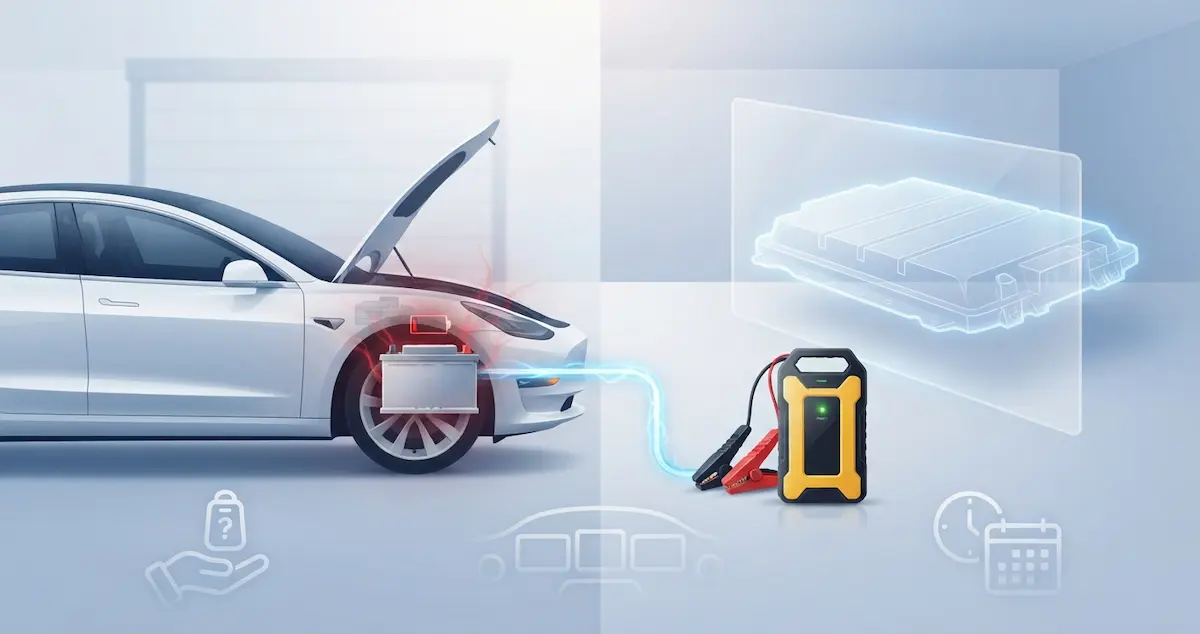
Your electric car needs a jump start — but you thought EVs didn’t have that problem. Or maybe you’re trying to figure out why an EV would ever need a jump start at all when it has a massive battery pack. This guide explains exactly why it happens and what you need to know.
Quick Answer
EVs need jump starts because of the 12V auxiliary battery — a small, separate battery that powers all the car’s electronics. When it dies, the car won’t start even with a fully charged main battery. This is identical to what happens in conventional cars. The main high-voltage pack never needs a jump start — only the 12V auxiliary battery does.
Why Does an EV Have a 12V Battery?
Every EV — Tesla, Chevy Bolt, Nissan Leaf, Hyundai Ioniq 5, Kia EV6, Ford Mustang Mach-E, Rivian, VW ID.4, BMW i4, Audi e-tron, Mercedes EQS, Polestar 2, and all others — has two separate battery systems:
- Main high-voltage battery pack: 200–900 volts, powers the electric motor, and is what gives you your range
- 12V auxiliary battery: Standard 12-volt battery, powers the computers, lights, locks, displays, audio, and all electronics
The reason EVs still use a 12V battery is that all the car’s electronic components — sensors, actuators, control modules, safety systems — are designed to run on 12V. Running them directly from the high-voltage pack would require expensive voltage regulation at every component. The 12V battery is a simpler, safer, standardized way to power all the car’s electronics.
When the car is running or plugged in, a DC-DC converter continuously steps down the main pack’s high voltage to charge and maintain the 12V battery. When the car is off and unplugged, the 12V battery slowly drains from standby power consumption — just like in a regular car.
Why Does the 12V Battery Die?
- Age: Most 12V batteries last 3–5 years. An old battery simply can’t hold a charge anymore.
- Always-on features: Tesla Sentry Mode, Rivian Camp Mode, alarm systems, cellular connectivity, and Bluetooth all draw power from the 12V battery even when the car is off.
- Extended parking without plugging in: If you don’t plug in for several days, the 12V battery will drain, leaving no way to recharge.
- Cold weather: Cold temperatures significantly reduce the 12V battery’s capacity. A battery that was fine at 50°F may not hold enough charge at 10°F to start the car.
- Software bugs: Some EV software bugs cause excessive background power draw, draining the 12V battery faster than normal. These are often fixed in OTA updates.
- Faulty DC-DC converter: If the component that recharges the 12V battery from the main pack fails, the 12V battery drains even when the car is plugged in.
How Often Does This Happen?
12V battery failure is the single most common reason EV owners call for roadside assistance. According to service data from multiple EV manufacturers, the 12V battery is responsible for more roadside calls than any other component — including the main battery pack. It’s especially common in EVs over 4 years old whose original 12V battery has never been replaced.
Tesla 12V batteries have historically had shorter lifespans than those in other EVs, partly due to higher background power draw from always-on features. Multiple Tesla software updates have addressed this by reducing standby power consumption. Nissan Leaf 12V batteries also have a reputation for dying prematurely.
What to Do When Your EV Needs a Jump Start
- Find the 12V jump-start terminals — check your owner’s manual for the location on your specific model (frunk, under hood, fuse box area)
- Use a portable jump starter or cables from another vehicle’s 12V battery
- Connect the red clamp to the positive (+) terminal, and the black clamp to a metal ground
- Wait 3 minutes, then try starting the car
- Once running, drive immediately to a shop or dealer to replace the 12V battery
⚠️ Only jump-start the 12V terminals. Never connect to orange high-voltage cables or the main charging port.
How to Prevent the 12V Battery From Dying
- Always plug in overnight: When plugged in, the DC-DC converter maintains the 12V battery from the main pack
- Turn off always-on features when not needed: Disable Sentry Mode, Camp Mode, and similar features when parked at home
- Replace the 12V battery proactively at 4 years: Don’t wait for it to fail
- Keep software updated: OTA updates often reduce background power draw
- Don’t leave the car unplugged for more than 2 weeks
Conclusion
EVs need jump starts because of the 12V auxiliary battery — not the main pack. It’s the same battery failure mode as any conventional car, just less expected in an EV. The fix is identical: jump-start the 12V terminals, get the car running, replace the battery that day. The best prevention is always to plug in overnight and proactively replace the 12V battery before it fails. Carry a portable lithium jump starter in your EV at all times — it’s the single most useful emergency item you can have.