Does Cold Weather Cause False EV Battery Warnings

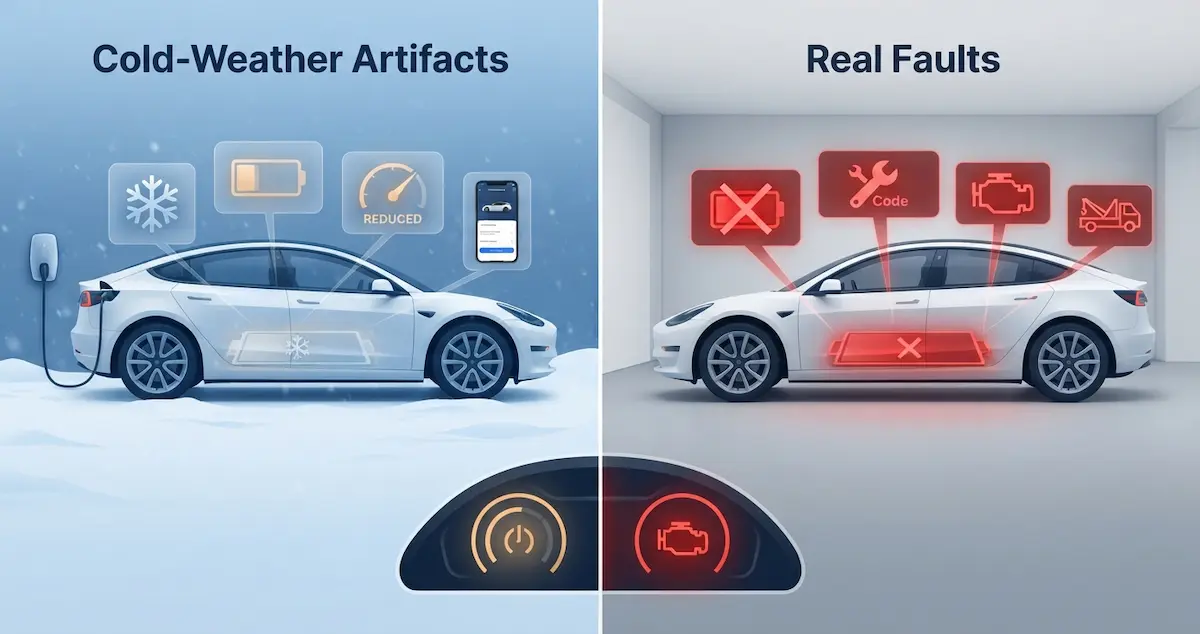
You live in a cold climate, and you’re getting battery warnings on your EV — but you’re not sure whether these warnings reflect real problems or whether the cold weather is making the car throw false alarms. This is a genuinely important distinction. Acting on a false warning wastes money; ignoring a real one creates risk. This guide tells you exactly which battery warnings are cold-weather artifacts and which are real faults requiring action.
Quick Answer
Yes — cold weather can cause EV battery warnings that are not hardware faults. The most common false-positive warnings in cold weather are power reduction advisories (battery too cold to deliver full current), range estimate warnings (range shows very low because the battery is cold), and charging rate advisories (DC fast charging slowed due to battery temperature). These resolve automatically as the battery warms. Real faults — isolation codes, cell voltage codes, contactor codes — are not caused by cold weather and don’t resolve when the car warms up.
Why Cold Weather Affects Battery Warning Systems
Lithium-ion battery chemistry is temperature-dependent. Cold temperatures slow the electrochemical reactions inside the cells — increasing internal resistance, reducing available power, and making the cells less efficient at accepting charge. The BMS monitors all of these parameters and has thresholds for acceptable ranges. In cold weather, multiple parameters approach or briefly exceed those thresholds — triggering warnings that reflect real physical conditions rather than hardware failures.
Battery Warnings That Cold Weather Commonly Causes
1. “Battery Power Reduced” / “Performance Limited”
Is it a false warning? Technically no — the BMS is correctly reporting that power is limited. But it’s not a fault. It’s a normal protective response to cold battery conditions.
Cold cells can’t safely deliver the same high current as warm cells. The BMS limits the motor current accordingly and displays a power-reduction warning. This is expected behavior, not a malfunction. The warning clears within 10–20 minutes of normal driving as the battery warms from use.
How to confirm it’s cold-related: The warning appears consistently at cold startups and clears after driving. It never appears when the car has been driven for 20+ minutes or when the battery has been preconditioned.
2. Low Range Warning at High SOC
Is it a false warning? The range estimate is accurate for cold conditions — but the battery isn’t damaged. It’s reflecting real temporary range reduction.
A cold battery provides less usable energy than a warm battery at the same stated charge percentage — the BMS’s range estimate accounts for this and may show a low range warning even when the battery shows 60–70% SOC. The estimated range recovers as the battery warms. If range is consistently low even after the battery warms to normal temperature, that indicates genuine degradation rather than cold-weather impact.
3. “Charging Slowed” / DC Fast Charging Rate Reduced
Is it a false warning? No — cold batteries genuinely can’t accept DC fast charge at full rate. Not a fault.
Below 32°F, lithium cells can’t safely accept high charging current — forcing fast charging into cold cells causes lithium plating, a form of irreversible damage. The BMS correctly limits DC fast charge rate in cold conditions. This is protective behavior. The rate increases as the battery warms during charging. Precondition the battery using built-in navigation to avoid this limitation at DC fast chargers.
4. Battery Temperature Warning (Amber)
Is it a false warning? Not exactly false — the battery is at a suboptimal temperature. But it’s not a fault.
An amber temperature warning at very cold startup reflects a real battery temperature reading that the BMS flags as outside its preferred operating range. It’s informational — not indicating damage or failure. Clears as the battery warms during driving.
5. SOC Jump or Inaccurate Reading at Cold Start
Is it a false reading? Temporarily, yes — cold voltage readings can cause the BMS to initially calculate SOC incorrectly.
Cold cell voltage is higher than warm cell voltage at the same SOC (a known characteristic of lithium chemistry). The BMS may initially overestimate SOC at a very cold start. As the battery warms and the voltage settles to temperature-corrected values, the SOC reading corrects — which can look like the percentage “dropped” even though no energy was used. This is normal and not a fault.
Battery Warnings That Cold Does NOT Cause — These Are Real Faults
| Warning / Code | Cold-Related? | Action |
|---|---|---|
| P0AA6 — Isolation Fault | No | Dealer immediately |
| P1E00 — Bolt Battery System Fault | No | Dealer immediately |
| P3101 — Leaf Battery Fault | No | Dealer immediately |
| BMS_a066 — Tesla battery module | No | Dealer immediately |
| Cell voltage fault code (any brand) | No | OBD2 scan + dealer |
| Contactor fault code | No | Dealer immediately |
| BMS communication error (persistent) | No | OBD2 scan + dealer |
The key test: does the warning clear after the battery warms up to its normal operating temperature (typically 60–80°F)? Cold-weather artifacts always clear when the battery is warm. Real hardware faults persist regardless of temperature.
How to Tell the Difference
Test 1: Does the warning clear after 15–20 minutes of driving?
Drive the car gently for 15–20 minutes without extreme acceleration or fast charging. If the warning clears as the battery warms, it’s cold-related. If the warning persists after the battery has warmed up (monitored via the companion app’s temperature display or an OBD2 scanner), it’s a real fault.
Test 2: Does the warning appear in warm weather?
A cold-weather artifact only appears in cold weather. If you get the same warning on a 70°F day, it’s not a temperature artifact — it’s a hardware condition that also appears in cold weather.
Test 3: OBD2 scan for stored codes
Scan for fault codes after the battery has warmed up and the warning has cleared. Cold-weather advisory codes may or may not leave stored codes behind — and the codes that remain after warming tell you whether the BMS flagged a transient temperature condition or a hardware fault. Isolation fault codes, cell voltage codes, and contactor codes don’t result from cold temperatures alone.
How to Reduce Cold-Weather False Warnings
- Precondition the battery: Use the companion app to start battery preconditioning 20–30 minutes before driving in cold weather. This warms the battery using grid power before you unplug — reducing or eliminating cold-start advisory warnings.
- Use built-in navigation for DC fast chargers: This triggers automatic battery preconditioning en route. CarPlay and Google Maps do not trigger this on most EVs.
- Park in a garage: Even an unheated garage is typically 20–30°F warmer than outdoor temps — enough to significantly reduce the frequency of cold-start advisories.
- Keep the charge above 20% in winter: Very cold batteries with a charge below 20% are more prone to triggering protective thresholds. Keeping more charge in winter reduces advisory frequency.
Conclusion
Cold weather genuinely causes EV battery advisory warnings — power reduction, slow charging, range reduction — that are normal protective responses, not hardware faults. These clear when the battery warms up. Real faults (isolation codes, cell voltage codes, contactor codes) don’t clear when the battery warms — they persist regardless of temperature and require dealer attention. The test is simple: does the warning clear after 15–20 minutes of driving? If yes, it’s cold-related. If no, get an OBD2 scan and contact your dealer.