Why Does My EV Only Charge at Half Speed?

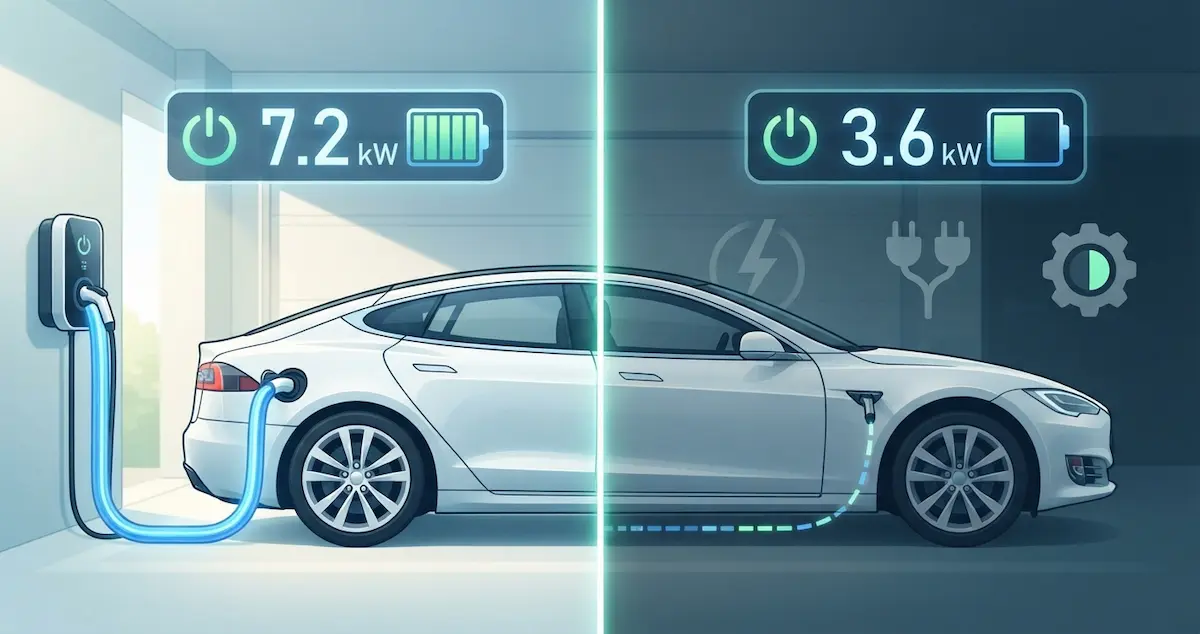
Your EV is charging at exactly half the speed you expect — a 32A EVSE delivers 16A, a 7.2 kW charger delivers 3.6 kW, or a DC fast charger that should reach 150 kW caps at 75 kW. Exactly half speed is a very specific pattern with specific causes. This guide explains why it happens and how to fix it.
Quick Answer
Charging at exactly half speed almost always has one of two causes: the EVSE is in a power-sharing mode splitting its output between two stalls, or the car’s charge current setting has been halved (either accidentally or by a software change). True hardware faults that produce exactly half speed are unusual — they tend to produce other fractions or erratic output rather than a precise 50% reduction.
Why Exactly Half Speed?
Reason 1: EVSE power sharing between two stalls
This is the most common cause of exactly half speed at DC fast chargers. Many DC charging sites share a single power cabinet between pairs of stalls. When both stalls in a pair are occupied simultaneously, the available power is split 50/50 between them. A 150 kW cabinet shared between two cars delivers 75 kW each. Move to a stall that isn’t paired with an occupied stall and speed immediately doubles.
This also happens with Tesla Supercharger V2 sites — paired A/B stalls share 150 kW. If A is occupied, B gets a maximum of 75 kW. V3 Supercharger sites (250 kW per stall) don’t share power between stalls.
Reason 2: Charge current setting halved in car settings
Many EVs allow you to set the maximum charge current. If this setting were halved — perhaps by a software reset that changed the default, or by an accidental touch on a slider — the car would draw only half of what it’s capable of, regardless of what the EVSE can deliver. Check the charge current setting on the car’s charging screen or in the app.
- Tesla: Charging screen → amps slider — should be at the maximum for your EVSE
- Hyundai / Kia: Settings → EV → AC Charging Current
- Chevy Bolt: Energy → Charging → Charge Rate
- Ford: FordPass app → Charging Settings
- Rivian: Charging settings in the vehicle menu
Reason 3: Single-phase vs. three-phase power
Some European EVs imported to North America have onboard chargers optimized for three-phase 400V AC power. In North America’s single-phase 240V system, only one phase is used — which delivers approximately half the power of a three-phase installation. If you have a European-spec vehicle in North America, this is a hardware characteristic, not a fault.
Reason 4: Dual onboard charger — one module failed
Some higher-end EVs (older Tesla Model S/X, BMW i8) had dual onboard charger modules that operated in parallel to achieve higher AC charging speeds. If one module fails, the remaining module delivers exactly half the rated AC Level 2 charging speed. DC fast charging typically uses a separate pathway and may be unaffected. If your older Tesla or premium EV suddenly charges at exactly half its previous Level 2 speed, a dual charger module failure is the likely cause — requires dealer service.
Reason 5: EVSE load management halved the output
Smart EVSEs with load management (Emporia, Wallbox, ChargePoint Home Flex) automatically reduce charge current when other home loads are high. If the load management algorithm determined that exactly half output was the right balance at the time you observed the reduced speed, it may be a correct, intentional reduction — not a fault. Check the EVSE app to see whether load management is active and what it reports as the reason for reduced output.
Reason 6: EVSE firmware defaulting to 50% output
Some EVSEs ship with a default 50% current output for safety and then need to be configured to the full rated current via the app or a configuration jumper. If a factory reset occurred — due to a power outage or a firmware update — the EVSE may have reverted to its 50% default. Open the EVSE app and check the configured maximum current output setting.
How to Fix Half-Speed Charging
Fix 1: Move to an unshared stall (DC fast charging)
For public DC fast charging at half speed, move to a stall that isn’t paired with an occupied stall. Check the charger or the network’s app to see which stalls share a cabinet. Often the station layout shows paired stalls (1A/1B, 2A/2B, etc.) — choose a stall whose pair is unoccupied.
Fix 2: Raise the charge current in the car’s settings
Open the car’s charging menu and raise the amps slider to the maximum supported by your EVSE. Save the setting and start a new charging session. This immediately resolves the issue if the cause was a change in settings.
Fix 3: Check and configure the EVSE output setting
Open the EVSE’s companion app and look for a maximum output setting. If it shows 16A when it should be 32A (or 50% of its rated maximum), raise it to the full rated current. Some EVSEs have a physical DIP switch or jumper for current selection — check the installation manual if the app doesn’t have a current setting.
Fix 4: Disable load management temporarily to test
If load management is active, temporarily disable it in the EVSE app and check whether charging speed returns to normal. If it does, adjust the load management threshold so it doesn’t reduce charging as aggressively in normal conditions.
When to Contact a Dealer
Contact a dealer if Level 2 charging is consistently at half speed with the correct current setting in the car, on a properly configured EVSE, with no load management active — especially on an older Tesla Model S/X or other vehicle with a dual onboard charger architecture. A failed charger module is the likely cause and requires dealer diagnosis and repair.
Conclusion
Exactly half-speed charging is almost always caused by power sharing between paired stalls at a public DC charger, or by a charge current setting halved in the car or EVSE settings. Both are quick fixes — move stalls or raise the setting. For Level 2 charging at exactly half speed with no setting explanation on an older premium EV, a dual onboard charger module failure is likely and needs dealer diagnosis.