EV Charging Troubleshooting: 10 Most Common Problems Solved

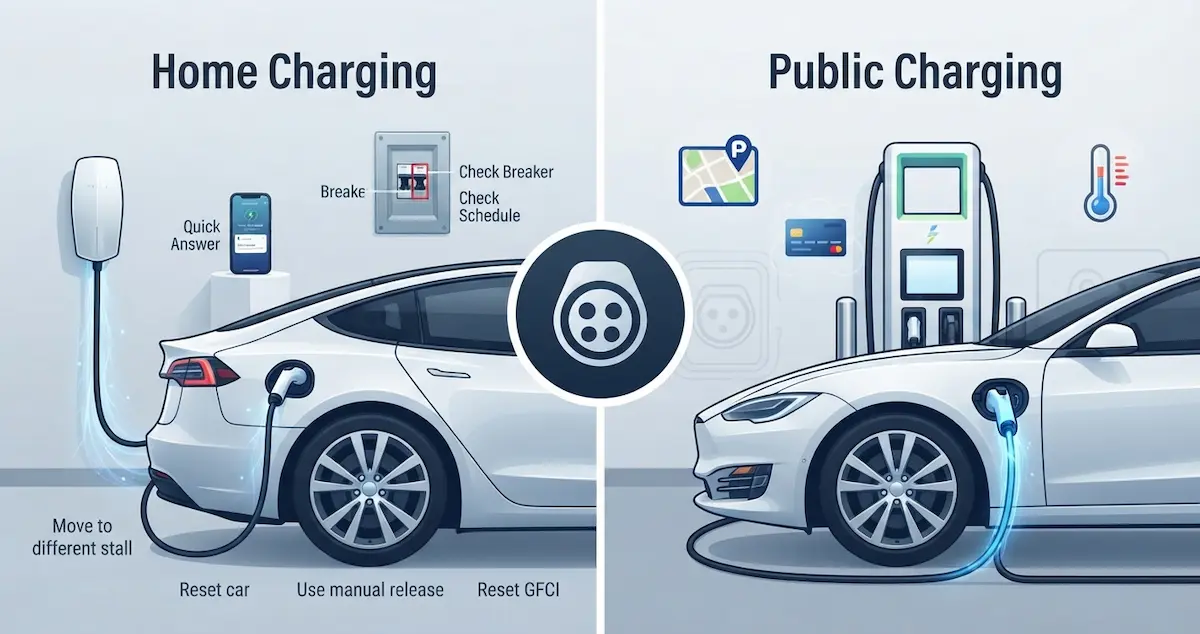
Your EV isn’t charging, and you need to figure out why — fast. This guide is the complete EV charging troubleshooting resource. It covers every type of charging problem, from Level 1 to DC fast charging, provides a clear diagnostic sequence, and tells you exactly when a problem is fixable at home versus when you need a dealer. Use the table of contents to jump to your specific issue.
Quick Answer
Before anything else, try these three steps in order:
- Unplug, wait 2 minutes, plug back in firmly. This fixes roughly 30% of all charging failures by resetting the communication handshake between the EVSE and car.
- Check the circuit breaker. Flip it fully OFF, wait 30 seconds, and flip it firmly back ON. This fixes another 20–25% of home charging failures.
- Check your charging schedule. Open the companion app and confirm no scheduled delay is blocking the charge. This explains another 15–20% of “why won’t it charge” reports.
If those three steps don’t resolve it, continue through this guide.
Identify Your Charging Problem Type
| Symptom | Most Likely Cause | Jump To |
|---|---|---|
| Nothing happens when plugged in at home | Breaker, GFCI, EVSE fault, schedule | Home Charging Won’t Start |
| Charging starts then stops | Charge limit reached, thermal, communication fault | Charging Stops Mid-Session |
| Charging is much slower than expected | Current setting, cold battery, circuit | Slow Charging |
| Won’t charge past 80% | Charge limit set to 80% | Charge Limit Issues |
| Public DC fast charger not working | Broken stall, authentication, cold battery | Public Charging Problems |
| Charge port won’t open or cable stuck | Car locked, latch fault | Charge Port Problems |
| EV shows error message | Varies by code | Error Messages |
| Won’t charge in cold weather | Normal BMS protection — preconditioning needed | Cold Weather Charging |
| Charger trips the breaker | Incorrect sizing, aging breaker | Breaker Problems |
Home Charging Won’t Start
Complete diagnostic sequence
- Check the circuit breaker — find the 240V double-pole breaker in your panel. Flip firmly OFF, wait 30 seconds, then back ON.
- Check the EVSE indicator lights — solid green = ready, blinking green = charging, red = fault. A red light means the EVSE detected a problem. Note how many times it blinks (Tesla Wall Connector blink count identifies the specific fault).
- Check the charging schedule — open your car’s companion app and look for any scheduled delay. Clear it and tap “Start Charging.”
- Check the charge limit — if the battery is already at or above it, the car won’t charge. Lower the limit below current SOC.
- Reset the EVSE — flip the EVSE breaker OFF for 60 seconds, then back ON. Wait 60 seconds for the self-test to complete.
- Check the GFCI — for plug-in EVSEs, press the RESET button on the outlet. For GFCI breakers, reset at the panel.
- Clean the charge port — use compressed air to clear debris. Push the connector in firmly until it clicks.
- Test with portable cord — if the car charges on the portable cord but not the wall EVSE, the wall unit has the fault. If neither works, the car has the fault.
- Check the 12V battery — a dead 12V prevents the charging system from initializing. Test with a 12V voltmeter; below 11.5V at rest indicates a failing battery.
Charging Stops Mid-Session
Diagnostic questions
- Did it stop exactly at the charge limit? → Normal. Raise the limit if you want to charge more.
- Did it stop after 1–2 hours? → Possible EVSE relay overheating or GFCI trip. Reset the EVSE and check connection quality.
- Did the battery show “Charging paused — temperature”? → Thermal protection. Wait for the battery to cool/warm, and charging resumes automatically.
- Did it stop with no error and no apparent reason? → J1772 communication dropout. Unplug and replug to reset the handshake.
- Does the EVSE app show “Session Ended by Vehicle”? → The car’s BMS stopped the session. Check for BMS fault codes via OBD2.
Slow Charging
Slow Level 2 at home
- Check the charge current setting in the car — is it set to maximum for your EVSE’s output?
- Is the battery cold? Below 40°F reduces the charge rate. Precondition before plugging in.
- What’s your EVSE’s rated amperage? Verify your circuit supports it (EVSE amps × 1.25 = minimum breaker size).
- Is the EVSE shared with other loads? A dedicated circuit is required for maximum speed.
Slow DC fast charging
- Is the battery above 80% SOC? DC charging naturally slows above 80%.
- Is the battery preconditioned? Navigate to the charger in built-in navigation to trigger preconditioning.
- Are you on a shared stall? Move to an unshared stall or higher-power station.
- Is it your second fast charge today without a cooling break? Allow 20–30 minutes of cooling between sessions.
- Is it cold weather? Warm the battery first — low initial rates from cold are normal and increase as the battery warms.
Charge Limit Issues
- Won’t charge past 80%: Charge limit is set to 80%. Change in car settings or app. For Chevy Bolt: recall software limits are set to 80–90% until the recall repair is complete.
- Won’t reach 100%: Run a BMS recalibration cycle (discharge to 10%, charge to 100%, hold for 1 hour). On Tesla, staying plugged in at 99% for 2 hours usually brings it to 100%.
- Charge limit resets to 80% after the update: the software update changed the default. Raise the limit manually after any software update.
Public Charging Problems
In order of what to try
- Move to a different stall. Broken stalls are the most common public charging problem. Try every stall at the site before assuming your car is the problem.
- Check your authentication — open the network’s app, verify your account and payment method are valid, and try initiating the session through the app rather than a card.
- Soft reset the car — unplug, reboot, wait 2 minutes, firmly replug.
- Precondition for cold weather — if below 40°F, the battery needs to warm before DC fast charging at full rate.
- Call network support — they can often remotely start a session or confirm whether the site is offline. Keep these numbers: Electrify America (833-632-2778), ChargePoint (888-758-4389), EVgo (877-494-3833), Tesla (877-798-3752).
- Check PlugShare — view real-time check-ins to confirm whether the site is working for other drivers.
Charge Port Problems
- Port won’t open: Unlock the car first. Cold weather may freeze the door — use lukewarm water to thaw. Use the manual release cord inside the car if electronic release fails.
- Cable stuck in port: Unlock the car. Use the companion app’s “Release Charge Port” command. Use the manual release cord (location varies by model — see the guide for your brand).
- Connector won’t seat: Inspect for debris or bent pins. Clean with compressed air. Try a different cable. Bent pins in the car’s port require dealer repair.
Error Messages — What They Mean
| Error Message | Cause | Fix |
|---|---|---|
| Unable to Charge | Communication failure | Unplug, reboot car, EVSE reset, replug |
| Check Charging Equipment | EVSE fault | Try different EVSE |
| Charging Paused: Temperature | Battery too hot or cold | Wait for temperature to normalize |
| Scheduled Charging Active | Delayed start set | Clear schedule or tap Start Now |
| Charge Port Error | Latch or sensor fault | Check port; use app to release |
| Ground Fault Detected | Wiring issue | Electrician required |
| High Voltage Battery Fault | BMS hardware fault | Dealer required |
| P0AA6 | HV isolation fault | Stop charging — dealer required immediately |
| P1E00 (Bolt) | Battery system fault | Dealer required |
| P3101 (Leaf) | Battery capacity fault | Dealer required |
| BMS_a066 (Tesla) | Battery module fault | Dealer required |
Cold Weather Charging
EV charging slows in cold weather because the BMS limits current to prevent lithium plating damage. This is protective and expected. How to maximize cold weather charging:
- Precondition before charging: Use the app to start preconditioning 20–30 minutes before you plan to charge (while still plugged into Level 2 if possible). Grid power warms the battery — not battery power.
- Navigate to DC fast chargers: Built-in navigation triggers automatic battery preconditioning. CarPlay/Google Maps do not.
- Be patient at DC fast chargers: Initial cold-rate output of 10–30 kW is normal. They increase as the battery warms — sometimes doubling within 10–15 minutes.
- DC fast charging refused at extreme cold: Below -4°F, many EVs won’t accept DC fast charging. Use Level 2 first to warm the battery.
Breaker Problems
- Breaker trips immediately on plug-in: Ground fault in EVSE, vehicle, or wiring. Stop using the circuit — electrician required.
- Breaker trips after 30–60 minutes: EVSE current exceeds 80% of breaker rating (NEC violation). Reduce EVSE current setting or upgrade to a larger breaker on a heavier wire.
- Breaker trips randomly: Loose wiring connection or aging breaker. Electrician inspection required.
Safety Warnings — When to Stop Immediately
⚠️ Stop charging immediately and call an electrician or dealer if you experience any of the following:
- Burning smell from the charging cable, connector, or outlet
- Visible melting, discoloration, or smoke from any component
- The EVSE’s GFCI trips every time you plug in (indicates a ground fault in wiring or vehicle)
- A “P0AA6” or “High Voltage Isolation Fault” error code on any EV
- The EV battery compartment is hot to the touch or shows visible swelling
- The car sparks when connecting the charge cable
These are potential safety hazards — do not attempt to work around them.
When to Contact a Dealer vs. Fix It Yourself
| Problem | DIY Fix? | Dealer Needed? |
|---|---|---|
| Tripped breaker | Yes — reset breaker | Only if keeps tripping |
| Charging schedule conflict | Yes — clear schedule | No |
| Charge limit at 80% | Yes — change setting | No (unless Bolt recall) |
| Cold battery slow charge | Yes — precondition | No |
| Broken public stall | Yes — try different stall | No |
| J1772 communication error | Yes — reset both sides | Only if persistent |
| Ground fault / P0AA6 | No | Yes — immediately |
| Bent pins in charge port | No | Yes |
| Onboard charger failure | No | Yes |
| BMS battery fault | No | Yes |
| Burning smell from cable | No | Electrician first |
OBD2 Scanning — Before Going to the Dealer
A Bluetooth OBD2 scanner ($15–$50) reads fault codes from your EV’s BMS before you spend money on a dealer visit. Recommended scanners:
- ELM327 Bluetooth adapter: Works with most apps — best for general fault code reading
- LeafSpy (Nissan Leaf): Most detailed Leaf-specific BMS data available
- ScanMyTesla: Tesla-specific diagnostic app with detailed battery and charging data
- Car Scanner ELM OBD2: Excellent for most non-Tesla EVs
- Torque Pro: Popular general-purpose OBD2 app
Knowing the specific fault code before contacting the dealer lets you have a more productive conversation and helps confirm whether a repair is warranty-eligible.
Battery Warranty — Know Your Coverage
Federal law requires all EVs sold in the US to include an 8-year/100,000-mile battery warranty that covers both battery defects and capacity loss below the manufacturer’s stated minimum. Some brands offer more:
- Rivian: 8 years/175,000 miles
- Tesla Cybertruck AWD: 8 years/150,000 miles
- Hyundai Ioniq 5 / Kia EV6: 8 years/100,000 miles
- Ford Mach-E / Lightning: 8 years/100,000 miles
- Chevy Bolt: 8 years/100,000 miles (post-recall replacement batteries)
- Nissan Leaf: 8 years/100,000 miles
- VW ID.4: 8 years/100,000 miles
If a charging fault is confirmed to be a battery or BMS hardware issue and your car is within this coverage window, the repair should be free. Always document fault codes and charging failure dates before a dealer visit.
Conclusion
Most EV charging problems are fixable with a reset, a settings check, or a breaker reset — no dealer needed. Work through the diagnostic sequence for your specific symptom using this guide before calling a dealer or an electrician. Know your fault codes (get an OBD2 scanner), know your warranty coverage, and document everything before any service visit. When a problem is genuinely a hardware fault — confirmed by persistent symptoms, fault codes, and failed basic troubleshooting — the 8-year battery warranty likely covers it.