Why Is My EV Battery Range Different in Sport vs Eco Mode?

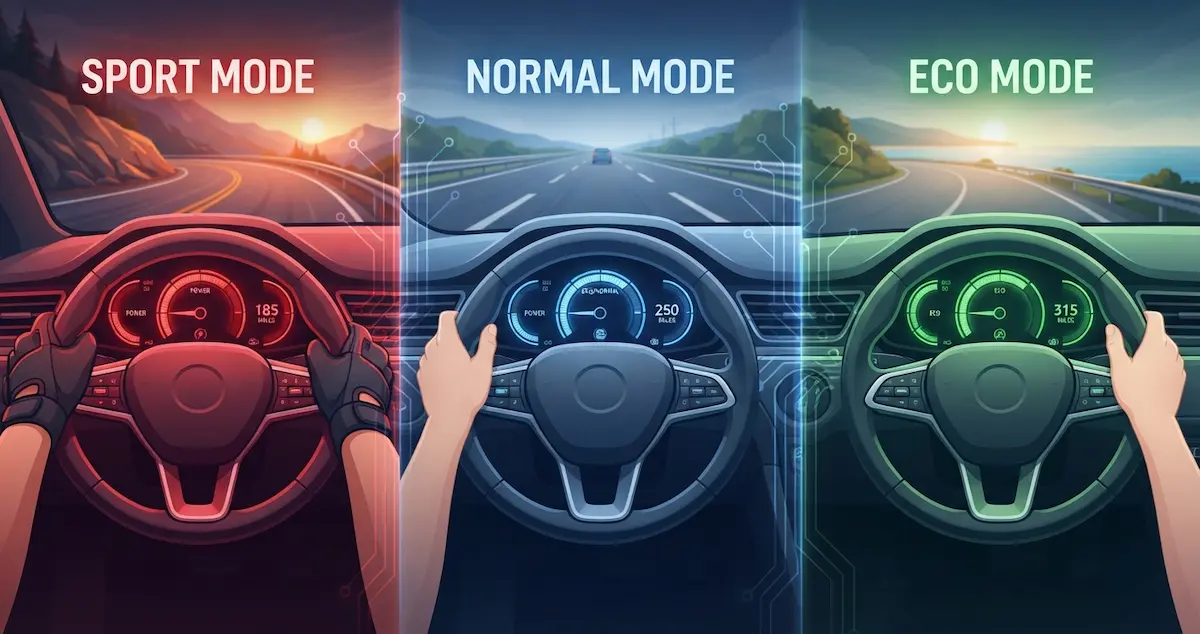
You can switch an EV from Sport to Eco and suddenly see dozens of extra miles on the range display. But is Eco mode really saving that much energy, or is the car simply changing its estimate?
Quick Answer
EV drive modes can affect range by changing motor power delivery, climate control, throttle response, and regenerative braking. Eco or Range modes usually reduce energy use by limiting peak power and softening heating or cooling. Sport mode gives the motor more power and sharper throttle response, which can reduce range when you use that extra performance.
The actual difference depends heavily on your driving style. A driver using Sport mode gently may see only a small difference in range, while frequent hard acceleration and high-speed driving can reduce range much more.
What Do EV Drive Modes Actually Change?
Drive modes do not change the basic chemistry of the battery. Instead, they change how the vehicle uses the energy stored in the battery.
Depending on the EV, a drive mode can change:
- Motor power and acceleration
- Throttle response
- Heating and air conditioning
- Regenerative braking
- Top-speed limits
- Steering and suspension settings
Not every EV changes all of these settings. The exact behavior depends on the manufacturer and model.
What Changes in Eco Mode?
Eco mode is designed to reduce energy consumption. It usually does so by making several small changes rather than imposing a single major restriction.
Motor power limit: Some EVs limit peak motor output in Eco mode. You can still accelerate normally, but the vehicle may not provide the same instant power available in Sport mode.
Throttle mapping: Eco mode often makes the accelerator less sensitive. Pressing the pedal halfway may produce less motor power than it would in Sport mode. This encourages smoother acceleration.
Climate control: Some manufacturers reduce the maximum output of the heater or air conditioner in Eco mode. The system still keeps the cabin comfortable, but it may work more slowly or use less peak power.
Regenerative braking: Some vehicles increase regenerative braking in their efficiency modes. More energy can then be recovered when you slow down, although the benefit depends on the vehicle and driving conditions.
The biggest benefit of Eco mode often comes from changing driver behavior. When the car responds more gently, it becomes easier to avoid unnecessary bursts of acceleration.
What Changes in Sport Mode?
Sport mode is designed to prioritize performance instead of efficiency.
It may provide:
- Higher or unrestricted motor output
- Sharper accelerator response
- Stronger performance settings
- Different regenerative braking behavior
- More aggressive climate operation on some vehicles
Hard acceleration can create a very high instantaneous power demand from the battery. A motor may use several times more power during a strong acceleration event than it needs while cruising at a steady speed.
Sport mode itself does not force you to use that power. It simply makes the power available more quickly.
That distinction is important.
If you activate Sport mode but continue driving gently, the range penalty may be small. If Sport mode encourages you to accelerate hard and drive faster, energy consumption can rise dramatically.
What Changes in Normal Mode?
Normal mode is usually the manufacturer’s middle ground between efficiency and performance.
Motor response is generally smooth, climate control operates normally, and regenerative braking uses the vehicle’s default calibration.
For everyday driving, Normal mode is often the most balanced choice because it gives you normal performance without deliberately prioritizing either maximum efficiency or maximum acceleration.
How Much Range Do You Lose in Sport Mode?
There is no universal percentage because drive modes work differently across EVs.
The driver’s behavior usually matters more than the mode itself.
For example, consider a 300-mile EV:
| Driving mode | Possible range effect | Approximate impact on a 300-mile EV |
|---|---|---|
| Eco / Range | Around 10–20% improvement in some conditions | +30 to +60 miles |
| Normal / Comfort | Baseline | Baseline |
| Sport / Performance | Around 15–25% lower with moderate use | -45 to -75 miles |
| Sport with aggressive driving | Can be 30–50% lower | -90 to -150 miles |
These numbers should be treated as general examples, not fixed specifications.
A vehicle’s speed, temperature, road conditions, tire pressure, traffic, terrain, HVAC use, and acceleration habits can have a much larger effect than the drive mode alone.
Why Driving Style Matters More Than the Mode
Imagine two drivers using the same EV.
Driver A selects Sport mode but cruises at 55 mph, accelerates gently, and avoids unnecessary braking.
Driver B selects Eco mode but repeatedly accelerates hard, drives at 80 mph, and uses the heating or cooling at full strength.
Driver A could easily achieve better efficiency.
That is why it is incorrect to say that Sport mode automatically uses 25% more energy.
The mode changes what the vehicle allows and encourages. Your driving determines how much of that capability you actually use.
Does Sport Mode Hurt the EV Battery Long-Term?
Occasional use of Sport mode does not normally damage the battery.
EV batteries and their battery management systems are designed to handle high power demands within their specified operating limits. The BMS monitors factors such as battery temperature, voltage, and current and can limit power when necessary.
However, repeated high-power driving can create more heat and increase energy throughput. Heat and battery cycling are both important factors in long-term battery aging.
That does not mean you should avoid Sport mode.
The difference between normal driving and regular aggressive performance driving is more important than simply selecting the Sport setting.
A driver who occasionally enjoys full acceleration is unlikely to notice a meaningful battery-life penalty from the drive mode itself. The bigger concern is frequent high-power use combined with high temperatures and other stressful conditions.
So, use Sport mode when you want it. Just don’t assume that selecting Eco mode alone will dramatically extend battery life.
When Should You Use Each EV Drive Mode?
The best mode depends on what you are trying to achieve.
Use Eco or Range Mode When:
- You are taking a long road trip.
- Your battery charge is getting low.
- You have a long distance to travel before the next charger.
- You are driving in heavy traffic.
- Cold or hot weather is reducing your range.
- You want to maximize efficiency.
Eco mode is especially useful when you have a specific range target. If your next charging stop is 30 miles away and the battery is already low, the small efficiency gains can become useful.
Use Normal Mode When:
- You are commuting to work.
- You are running daily errands.
- You have plenty of battery charge.
- You want normal acceleration and comfort.
- Range is not a major concern.
For most EV owners, Normal mode is a good everyday setting.
Use Sport Mode When:
- You want stronger acceleration.
- You are enjoying a performance drive.
- You need quick acceleration to merge or pass.
- You have enough battery charge.
- Maximum range is not your priority.
There is no reason to avoid Sport mode simply because you are worried about damaging the battery immediately.
Do EV Drive Modes Change Regenerative Braking?
Yes, some EVs change regenerative braking when you select a different drive mode.
Regenerative braking allows the electric motor to act as a generator when the vehicle slows down. Some of the vehicle’s kinetic energy can then be converted back into electrical energy and sent to the battery.
However, regen is not free energy.
Energy is lost during the conversion process, so you cannot recover all the energy used to accelerate the vehicle.
Some Eco modes increase regenerative braking to improve efficiency. Other vehicles allow drivers to adjust regen separately from the drive mode.
The exact behavior depends on the EV.
Do Drive Modes Change Climate Control Energy Use?
They can.
Heating and air conditioning can consume a meaningful amount of electricity in an EV, especially in extreme temperatures.
Some Eco modes reduce the HVAC system’s maximum output or change how aggressively it approaches the selected temperature.
This can improve efficiency, but the effect varies significantly between vehicles.
In cold weather, cabin heating can have a particularly noticeable effect on range. In hot weather, air conditioning can also increase energy consumption.
That means an Eco mode that reduces HVAC output may provide a greater benefit in extreme weather than on a mild day.
Do Drive Modes Change the Range Display?
Yes, some EVs can change their estimated range after you select a different drive mode.
For example, switching from Sport to Eco can increase the displayed range estimate.
The reason is that the vehicle’s range calculation uses expected energy consumption and recent driving behavior. If the vehicle is expected to use less energy in Eco mode, its estimate may change.
However, the increase on the dashboard is an estimate, not extra energy added to the battery.
If the battery contains the same amount of energy before and after changing modes, the mode change has not magically charged the battery.
Instead, the vehicle estimates you can travel farther because it expects you to use less energy per mile.
How Different EV Brands Handle Drive Modes
Drive modes are not standardized across the EV industry. Two vehicles can use the same name for a mode but make completely different changes.
1. Tesla
Tesla does not use traditional Eco and Sport labels across its lineup.
Chill Mode reduces acceleration response and works somewhat like an efficiency-focused setting. With Chill Mode disabled, the vehicle can operate normally.
The actual range difference depends heavily on how aggressively the vehicle is driven.
2. Hyundai Ioniq 5 and Kia EV6
The Hyundai Ioniq 5 and Kia EV6 offer drive modes such as Eco, Normal, and Sport.
Eco mode generally provides a softer power response and can adjust other vehicle systems to improve efficiency.
The real-world range difference between Eco and Sport can be significant when Sport mode is combined with aggressive acceleration.
3. Ford Mustang Mach-E
The Mustang Mach-E uses modes including Whisper, Engage, and Unbridled.
Whisper is focused more heavily on efficiency and smooth driving, while Unbridled provides a more performance-focused driving experience.
The range difference depends on how much of the additional performance is actually used.
4. Rivian
Rivian vehicles can offer modes such as Conserve, All-Purpose, Sport, Off-Road, and Tow.
Conserve is designed to maximize efficiency, while Sport prioritizes performance. Off-Road and Tow modes can also increase energy consumption due to the conditions and loads for which they are intended.
If range is your priority, an efficiency-focused mode is generally the better choice.
5. Chevrolet Bolt
The Chevrolet Bolt uses settings such as L mode for stronger regenerative braking and one-pedal driving.
Its efficiency is heavily influenced by driving conditions and driving style, so changing the setting does not automatically produce a large increase in range.
6. Volkswagen ID.4
The Volkswagen ID.4 offers drive modes that can change power delivery and other vehicle behavior.
Its Eco setting is designed to prioritize efficiency and can make stronger efficiency interventions than simply changing accelerator response.
Always check your specific model year’s owner’s manual because software and drive-mode behavior can change between versions.
7. BMW i4
The BMW i4 offers modes such as Efficient, Comfort, Sport, and Sport Boost, depending on the model and configuration.
Performance-focused settings can make much more power available. Using that power frequently can quickly reduce range.
Efficient mode is designed to prioritize lower energy consumption.
8. Audi Q4 e-tron
Audi uses modes such as Efficiency, Comfort, Auto, and Dynamic on its electric models.
Efficiency mode is designed to reduce energy consumption by changing vehicle behavior, while Dynamic focuses more on performance.
Again, the actual range difference depends on how the vehicle is driven.
Does Eco Mode Always Give Better Range?
No.
Eco mode can help reduce energy consumption, but it cannot overcome inefficient driving conditions.
For example, driving an EV at 85 mph in Eco mode can still consume far more energy than driving at 55 mph in Normal mode.
Other factors can also dominate the result:
- High highway speeds
- Cold temperatures
- Strong headwinds
- Heavy cargo
- Low tire pressure
- Steep hills
- Aggressive acceleration
- Heavy HVAC use
The drive mode is only one part of the efficiency equation.
Is Eco Mode Better for Daily Driving?
It depends on your priorities.
If you want the highest possible efficiency and do not mind slower accelerator response, Eco mode can be useful every day.
But you do not need to use Eco mode constantly to protect your battery.
For many drivers, Normal mode provides a better balance between comfort, performance, and efficiency. Using Eco mode when range actually matters is often more practical.
Conclusion
EV drive modes can make a real difference in energy consumption, but the effect varies by vehicle.
Eco or Range mode usually reduces power delivery and may reduce HVAC energy use. Normal mode provides a balanced driving experience. Sport mode unlocks stronger performance, which can reduce range when you use the additional power.
Sport mode does not automatically damage the battery, and Eco mode does not magically increase the battery’s stored energy. The biggest difference comes from how you drive.
For everyday use, Normal is a sensible choice. Use Eco or Range for maximum efficiency, especially on long trips or when the battery is low. Save Sport mode for situations where acceleration and driving enjoyment matter more than maximum range.