
Why Is My EV Battery Reading Incorrect SOH

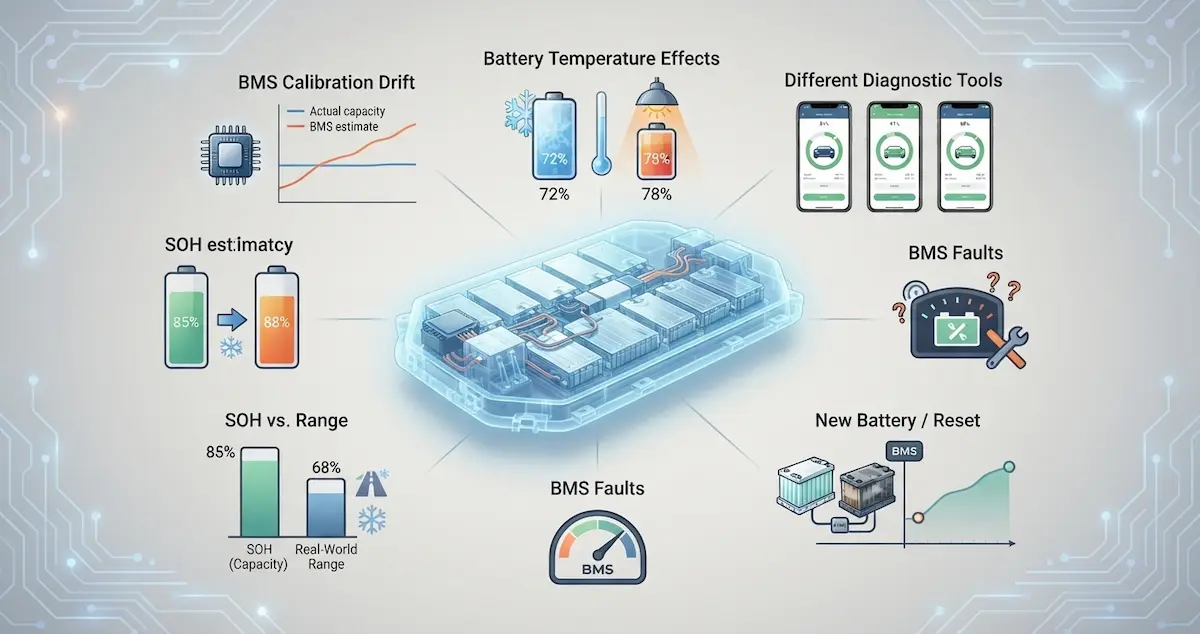
Your EV can show an SOH percentage that seems completely wrong. The car may drive normally and charge without problems while showing 68% health. In another case, the battery may show 85% SOH even though the real-world range seems much lower.
The good news is that an unusual SOH number does not always mean the battery is damaged. SOH is an estimate calculated by the battery management system (BMS), and several factors can affect that estimate.
Quick Answer
EV battery SOH can be inaccurate because the BMS estimate can drift over time, battery temperature can affect the data used in the calculation, and different diagnostic tools may use different SOH formulas. A recently reset BMS, limited battery data, software updates, or a BMS hardware fault can also cause an unusual reading.
For a more reliable result, use the same EV-specific diagnostic tool under similar conditions each time. A controlled BMS calibration cycle may also help the system update its capacity estimate. If the SOH changes by several percentage points between readings or appears with battery fault codes, have the vehicle checked with an OEM diagnostic tool.
Why EV Battery SOH Readings Can Be Inaccurate
BMS calibration drift
The battery management system does not directly measure SOH with a single sensor. Instead, it estimates the battery’s remaining capacity by using information such as voltage, current, temperature, charge history, and other battery data.
Over time, the BMS builds and updates an internal model of the battery.
If the vehicle is almost always operated within a limited state-of-charge range, the BMS may have less information about the battery’s behavior near the upper and lower ends of its usable range. That can make the displayed SOH less accurate.
For example, someone who regularly charges from 20% to 80% may rarely use the battery near its upper and lower limits. Depending on the vehicle’s BMS strategy, the system may have fewer opportunities to update its capacity estimate.
A calibration cycle can sometimes help the BMS improve its estimate. However, the exact procedure varies by EV manufacturer, so you should follow the procedure recommended for your specific vehicle rather than assuming every EV needs the same cycle.
Battery temperature affects the reading
Battery temperature can also affect SOH calculations.
Lithium-ion battery voltage and internal resistance change with temperature. A cold battery can behave differently from the same battery at normal operating temperature. Because the BMS uses electrical measurements and temperature data to estimate battery condition, the calculated SOH can be affected by measurement conditions.
For example, an SOH reading taken when the battery is very cold may not match a reading taken after the battery has warmed up.
This can create the appearance that battery health has improved during warmer weather. In reality, the physical battery may not have gained capacity. The measurement conditions simply changed.
For the most useful comparisons, take SOH readings under similar conditions. Try to keep the battery temperature, SOC, and resting time reasonably consistent.
Different diagnostic tools use different SOH calculations
One of the biggest reasons for confusing SOH readings is that SOH is not calculated in exactly the same way by every tool.
Different diagnostic applications may access different BMS parameters or process the same raw data differently. Some may estimate remaining capacity from amp-hours, while others may use energy capacity or another manufacturer-specific parameter.
For example, a Nissan Leaf owner using LeafSpy may see an SOH value based on battery capacity data. A Tesla diagnostic application may use different battery parameters and calculations.
As a result, two tools can show different percentages for the same vehicle without either tool necessarily being defective.
If one tool reports 84% and another reports 91%, don’t immediately assume that one battery reading is wrong.
Instead, check what each tool is actually measuring.
For long-term battery tracking, use the same EV-specific tool and compare readings taken under similar conditions.
A BMS fault can produce unreliable calculations
A more serious possibility is a problem with the battery management system itself.
The BMS depends on several sensors and electronic components to monitor the battery. These can include cell voltage monitoring circuits, temperature sensors, current sensors, and communication circuits between battery modules.
If one of these components fails or sends incorrect information, the BMS may end up with bad data to work with.
That can result in an SOH value that does not accurately reflect the battery’s actual condition.
A BMS-related problem is more concerning when the SOH reading changes dramatically between consecutive measurements or occurs alongside battery-related diagnostic trouble codes.
For example, a stable 78% reading is very different from readings that jump from 78% to 70% and then back to 77% without a meaningful change in battery use.
If the reading is unstable or fault codes are present, professional diagnosis is preferable to recalibrating the battery yourself.
A new battery or reset BMS may not have enough data
A BMS needs battery data to build an accurate estimate.
A vehicle with a new battery, recently replaced BMS module, or reset battery management system may not have enough operating history to produce a well-settled SOH estimate.
The initial number can therefore change as the vehicle collects more data.
This is especially important when checking the health of a replacement battery. A single SOH reading immediately after installation may not tell you much about the battery’s long-term condition.
Instead, monitor the reading over several normal charging and driving sessions.
The important thing is to look for a stable trend rather than one isolated percentage.
A software update can change the SOH calculation
Modern EVs rely heavily on software to manage their batteries. Manufacturers can update BMS software via over-the-air updates or during dealer service.
A software update can change how battery data is processed, displayed, or normalized.
As a result, you may notice that the displayed SOH changes after an update even though the battery has not suddenly gained or lost a large amount of physical capacity.
If your SOH changes soon after a software update, compare the new reading with previous readings and check whether the manufacturer has changed its battery monitoring strategy.
A changed number does not automatically mean the battery changed.
How to Get a More Accurate EV Battery SOH Reading
You can make SOH tracking more useful by controlling the conditions under which you measure it.
- Use the same diagnostic tool: Pick a reliable EV-specific tool designed for your vehicle and use it consistently.
- Measure under similar conditions: Try to keep battery temperature, SOC, and resting time similar when comparing readings.
- Allow the battery to reach a normal temperature: Extremely cold or hot conditions can affect battery measurements.
- Give the BMS enough operating data: A recently reset BMS may need normal driving and charging sessions before its estimate becomes stable.
- Follow the manufacturer’s calibration procedure: Some vehicles have specific procedures for recalibrating or relearning battery capacity.
- Track several readings: A trend across multiple measurements is more useful than one SOH percentage.
- Use an OEM diagnostic test when necessary: If the reading appears abnormal or fault codes are present, dealer-level diagnostic equipment can provide a more in-depth assessment.
Don’t use a full discharge as a DIY test
It is worth making one important distinction here.
You may see advice online telling you to drive an EV down to 0% and charge it to 100% to recalibrate the battery. That is not a universal recommendation.
The battery’s displayed 0% does not necessarily mean the cells are physically empty. EV manufacturers normally keep protective buffers at the top and bottom of the battery’s usable range.
A manufacturer may also have a specific procedure for BMS learning or calibration.
So, don’t repeatedly deep-discharge the battery just to improve an SOH number. Follow the manufacturer’s instructions for your vehicle.
SOH Accuracy by Reading Source
| Reading Source | Accuracy | Notes |
|---|---|---|
| Vehicle dashboard (where available) | Moderate | BMS-calculated; subject to calibration drift |
| Companion app (Tesla, Hyundai, etc.) | Low–Moderate | Derived from BMS data; not all apps expose SOH |
| Vehicle-specific OBD2 app (LeafSpy, ScanMyTesla) | High | Reads BMS raw data; depends on recalibration state |
| Generic OBD2 app | Low | May not access EV-specific BMS modules |
| Third-party API service (Recurrent) | Moderate | API-derived; accuracy improves with more session data |
| OEM dealer diagnostic tool | Highest | Active tests + raw BMS data; most authoritative |
Why SOH and Driving Range Can Tell Different Stories
A common mistake is assuming that SOH directly equals the percentage of original driving range.
It doesn’t.
SOH mainly represents battery capacity, while real-world range also depends on energy consumption.
For example, imagine an EV originally had a usable capacity of 75 kWh. If its current usable capacity is around 60 kWh, its capacity-based SOH would be roughly 80%.
But the vehicle’s actual range depends on how efficiently it uses those 60 kWh.
A driver who averages 4.0 miles per kWh could travel farther than someone who averages 3.0 miles per kWh with the same battery.
Weather, speed, heating, air conditioning, road conditions, tire pressure, and driving style can all affect energy consumption.
That means a battery showing 82% SOH can sometimes deliver surprisingly good range.
Likewise, a battery with 90% SOH can deliver poor range when the vehicle is driven at high speeds in cold weather or with heavy HVAC use.
Bottom Line
An incorrect-looking EV battery SOH reading does not automatically mean the battery is failing. BMS estimation, temperature, different diagnostic methods, limited data, software changes, and BMS faults can all affect the displayed number.
For reliable tracking, use the same vehicle-specific diagnostic tool under similar conditions, and focus on trends rather than a single isolated reading. If the SOH changes dramatically, does not match other battery symptoms, or appears alongside fault codes, an OEM diagnostic test is the safest way to determine what is really happening.