Top 10 EV Battery Myths That Cause Unnecessary Worry

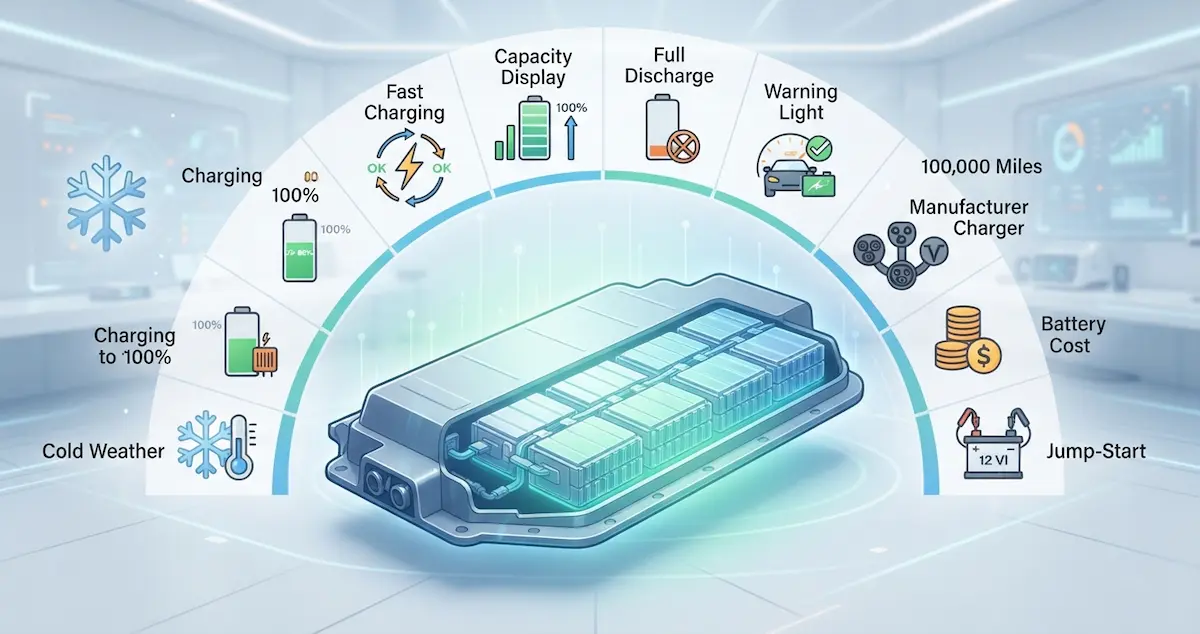
Did you know that many of the most common beliefs about electric vehicles circulating online are completely wrong? Acting on these misconceptions can lead to poor decisions regarding daily charging habits, expensive warranty claims, and vehicle maintenance. This guide breaks down the 10 biggest EV battery myths using actual facts and data.
Top 10 EV Battery Myths That Are Actually False
Myth 1: Cold Weather Permanently Damages Your EV Battery
The truth is that cold weather temporarily reduces your driving range and charging speed — it does not cause permanent damage. Lithium-ion cells slow down in freezing temperatures but recover their full functionality once they warm up.
Modern electric vehicles feature advanced thermal management systems explicitly designed to protect the battery pack in sub-zero conditions. Regularly plugging in your car during cold weather allows the system to use grid power to maintain an optimal battery temperature, further reducing cold-related wear.
Important Note: The only cold-related scenario that causes genuine physical damage is charging at a high current when the internal temperature is below freezing. This is why your Battery Management System (BMS) automatically slows down charging in cold weather to protect the hardware.
Myth 2: You Should Always Charge to 100%
Regularly charging your EV to 100% and leaving it sitting at maximum capacity accelerates long-term degradation. Lithium-ion cells experience heightened chemical stress at very high and very low states of charge.
- Keep your daily battery level between 20% and 80% to significantly extend its lifespan.
- Reserve 100% charges strictly for long road trips where maximum range is necessary.
- Follow guidelines from energy researchers who consistently recommend avoiding overnight maximum-capacity parking.
Myth 3: Fast Charging Always Destroys EV Batteries
Occasional DC fast charging does not significantly harm a well-designed modern EV power pack. Industry studies from organizations such as Recurrent and the Idaho National Laboratory show that infrequent fast charging has minimal impact on overall degradation.
The key distinction is frequency. Relying on DC fast charging as your primary, everyday method introduces extra heat cycles that can slightly accelerate wear over several years. However, utilizing fast chargers during a road trip will not ruin your vehicle.
Myth 4: A Full Battery Reading Means You Have Full Capacity
A displayed 100% charge indicates 100% of whatever capacity currently remains—not 100% of the original factory capacity. For example, a battery with an 85% state of health that reads 100% on your dashboard holds only 85% of its original energy capacity.
The display percentage is always relative to current capacity rather than original manufacturing capacity. This explains why an older vehicle showing a full charge may deliver noticeably less driving range than it did on day one.
Myth 5: EV Batteries Need to Be Fully Discharged Before Charging
This common misconception stems from outdated nickel-cadmium battery technology and does not apply to modern lithium-ion chemistry. Regularly draining your electric vehicle down to near zero places unnecessary stress on the cells and speeds up degradation.
While the BMS benefits from an occasional full discharge and recharge cycle to recalibrate its range estimates, doing this daily is harmful. Partial top-up charges are completely safe and actively preferred for daily driving routines.
Myth 6: A Warning Light Always Means the Battery Is Dying
Most EV battery warning lights are triggered by temporary environmental conditions or minor software glitches rather than actual cell failure. A yellow warning indicator is frequently caused by:
- Temperature extremes
- BMS calibration errors
- Known software bugs
True high-voltage pack failure is rare and typically presents multiple simultaneous symptoms rather than a single dashboard light. A simple software reset often clears most warnings without requiring hardware repairs.
Myth 7: EV Batteries Only Last 100,000 Miles
The 100,000-mile lifespan figure is outdated and applies primarily to early-generation electric vehicles. Modern packs are engineered to retain 70%-80% of their original capacity well beyond 100,000 miles.
Independent real-world analytics data show that most contemporary batteries maintain robust health for 150,000 to 200,000 miles of normal use. Major automakers back these components with standard 8-year or 100,000- to 175,000-mile warranties because the hardware is built to outlast those thresholds.
Myth 8: You Must Use the Manufacturer’s Charger for Good Battery Health
Any charging hardware that matches the correct voltage and current specifications for your vehicle is safe to use. Level 1 and Level 2 home equipment are heavily standardized, meaning standard connectors work seamlessly across compatible models.
DC fast-charging stations utilize universal standards, and your car’s onboard BMS manages every charging session regardless of the network brand. Utilizing third-party public charging networks is completely safe for your vehicle.
Myth 9: Replacing the EV Battery Always Costs $20,000
While a full high-voltage pack replacement can cost between $8,000 and $20,000 at a dealership for out-of-warranty models, most actual repairs involve module replacements. Instead of swapping the entire pack, technicians replace only the specific failed cell groups.
- Module replacements typically cost between $2,000 and $8,000.
- Third-party refurbished options for common models cost even less.
- Vehicles covered by the federal 8-year/100,000-mile warranty receive a full replacement at no cost.
Myth 10: You Can’t Jump-Start an Electric Car
You can jump-start the 12-volt auxiliary battery in an electric vehicle using the same method as for a conventional internal combustion car. The 12V system powers all the onboard computers and electronics required to boot the vehicle; when it dies, the car remains unresponsive even if the main high-voltage pack is fully charged.
Connecting jumper cables to the 12V terminals restores power to the core computers. However, you should never attempt to jump-start the high-voltage main drive pack yourself, as that requires specialized tools and trained professionals.
Bottom Line
Most popular beliefs regarding electric vehicle power systems are outdated, exaggerated, or inaccurate. Cold-weather effects are temporary, fast charging is safe in moderation, and warning lights rarely signal a total failure. Understanding the actual data helps you make better long-term decisions for your vehicle.
FAQs
Should I be worried about my EV battery?
In most cases, no. Modern EV power packs are engineered for exceptional longevity, backed by strict regulatory warranties, and governed by intelligent software. Most anxieties stem from outdated data. Follow basic daily routines—such as keeping your charge level between 20% and 80%—and your hardware will remain reliable for years.
What is the actual average EV battery lifespan?
Real-world tracking data demonstrates that most modern packs retain over 80% of their initial capacity through 150,000 miles under normal driving conditions. The lowest-performing outliers remain older vehicles lacking active thermal management systems.