Chevy Bolt P1E00 Code: Battery System Fault Guide


Your Chevy Bolt is showing fault code P1E00, either on the dashboard as “Service High Voltage Charging System” or through an OBD2 scanner. This is the Bolt’s most significant battery-related fault code and one that GM took very seriously during the 2021–2023 battery recall. This guide explains exactly what P1E00 means, what causes it, and what to do about it.
This guide belongs to our warning lights and error codes section. For the full overview, see Cold Weather EV Battery Warnings.
In Short
P1E00 on the Chevy Bolt means “Drive Motor Battery System Fault”, a broad battery system diagnostic code that signals the BMS detected an abnormal condition in the high-voltage battery pack. On the Bolt, P1E00 became particularly significant because it was associated with the battery cells capable of causing thermal events (fires) during the 2021–2023 recall. If your Bolt shows P1E00 and has not completed the recall battery replacement, stop charging above 90% and contact a GM dealer immediately.
The P1E00 / Bolt Recall Connection
In 2021 and 2022, GM issued multiple safety recalls for the Chevy Bolt EV (2017–2022) and EUV (2022) due to a risk of battery fires, specifically fires that occurred during or after charging. GM identified that certain cells manufactured by LG Energy Solution had two simultaneous manufacturing defects (a torn anode tab and a folded separator) that, when combined, could cause a thermal runaway.
P1E00 was a central fault code in the diagnostic process, it indicated a battery system anomaly that warranted investigation under the recall program. GM’s recall software update would analyze the battery data associated with P1E00 to assess whether the specific vehicle’s battery cells were at elevated risk. Vehicles determined to be higher risk required battery module replacement under the recall.
If your Bolt shows P1E00 and you haven’t completed the recall battery replacement, check your recall status at recalls.nhtsa.gov before doing anything else.
Common Causes of P1E00 on the Chevy Bolt
Cause 1: Battery module fault detected by BMS
P1E00 stores when the Bolt’s BMS detects that the battery pack’s state falls outside of expected parameters, this can mean a cell voltage anomaly, a temperature reading that’s outside the safe range, a cell balance deviation that’s too large, or a communication fault between the BMS and the cell monitoring modules. The specific sub-code determines the actual cause.
Cause 2: Recall-related diagnostic flag
On 2017–2022 Bolts, P1E00 can be triggered by the recall diagnostic software identifying battery cell conditions that need evaluation. This specific trigger doesn’t mean the battery is immediately dangerous, it means the battery data matched a pattern that the recall algorithm flagged for inspection.
Cause 3: Battery high-voltage contactor fault
A failing HV contactor, the relay that connects the battery pack to the rest of the car’s high-voltage system, can trigger P1E00. If the contactor doesn’t open or close as commanded, the BMS logs the circuit condition as a battery system fault.
Cause 4: Thermal event or temperature sensor fault
If the battery temperature exceeded safe limits (from overheating), or if a temperature sensor gave an erroneous reading, the BMS stores P1E00 as a precautionary alert. A temperature sensor fault can be repaired without replacing the entire pack, but requires dealer diagnosis to confirm.
Cause 5: 12V auxiliary battery interaction
As with many EVs, a very weak 12V auxiliary battery can cause BMS module power irregularities that generate false fault codes including P1E00. Always test the 12V battery before concluding the main pack has a genuine hardware fault.
What to Do If Your Bolt Shows P1E00
Step 1: Check recall status immediately
Go to recalls.nhtsa.gov, enter your Bolt’s VIN, and check whether any open recalls are associated with your vehicle. If your Bolt has an open battery recall, contact a GM dealer immediately. Do not charge above 90% or park the car inside a structure (garage or parking garage) until the recall has been completed.

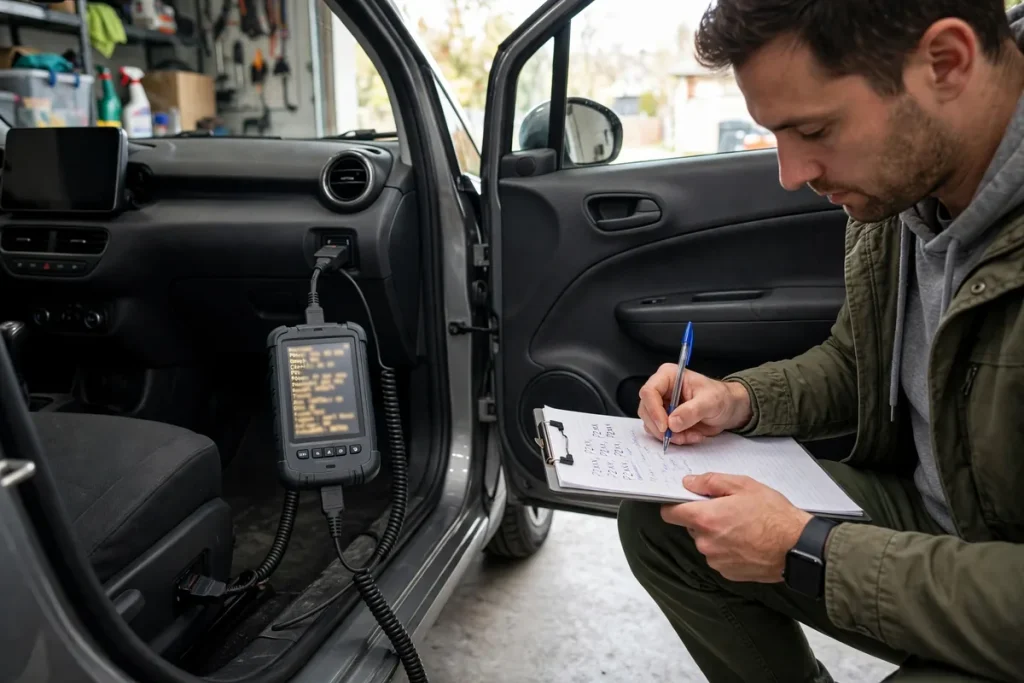
Step 2: Scan for sub-codes with OBD2
Use an OBD2 scanner compatible with the Bolt (ELM327 adapters with appropriate software work on the Bolt). Read all stored codes, P1E00 often appears alongside sub-codes that identify the specific system involved. Common associated codes:
- P0AA6: High-voltage isolation fault, serious, dealer required immediately
- P1FFF: Battery pack temperature sensor fault
- P0573: Cooling system fault
- B1001: BMS module communication fault
Step 3: Contact a GM dealer
Schedule a service appointment. Tell the service advisor that the car is showing P1E00 and provide any associated codes from your OBD2 scan. Ask specifically whether the car’s recall status is open or completed.

Step 4: Review warranty coverage
Chevy Bolt battery warranty covers 8 years/100,000 miles for battery defects. The recall battery replacements (2017–2022 Bolt EV and 2022 EUV) come with a separate warranty on the replaced modules. If P1E00 appears on a car with a recall-replaced battery, that repair may be covered under the replacement module warranty.
Can You Continue Driving a Bolt With P1E00?
If the recall has not been completed: limit charging to 90% maximum, don’t leave the car unattended while charging, and don’t park inside structures. This is GM’s official guidance for affected Bolts under the recall precautionary measures.
For a related problem, see Tesla Error Code CP_a139: What Does It Mean?.
If the recall has been completed and P1E00 appeared after: the car may still be drivable for short distances while awaiting a dealer appointment, but avoid DC fast charging and long trips. A post-recall P1E00 indicates a different issue from the original recall and needs fresh dealer diagnosis.
Chevy Bolt Battery Recall Summary
| Model Year | Recall Status | Fix |
|---|---|---|
| 2017–2019 Bolt EV | Covered under recall | Battery module replacement |
| 2020–2022 Bolt EV | Covered under recall | Battery module replacement |
| 2022 Bolt EUV | Covered under recall | Battery module replacement |
| 2023+ Bolt EV/EUV | Not covered (new battery design) | Standard warranty applies |
FAQs
My Bolt already had the recall battery replacement and now P1E00 is back: why?
A P1E00 that appears after a completed recall replacement is a different fault, the replacement modules are a separate batch from the recalled cells. This new P1E00 needs fresh dealer diagnosis without the recall framework. It may indicate a problem with the replacement module, a contactor issue, or an independent BMS fault. Contact the dealer and reference when the recall repair was completed.
Is P1E00 always dangerous?
Not inherently, it’s a broad fault code. The danger associated with P1E00 specifically in the recall context was from the underlying defective cells that could cause thermal runaway, not from the code itself. A Bolt with a completed recall replacement that shows P1E00 has different implications than an unrepaired Bolt showing the same code.
Conclusion
P1E00 on the Chevy Bolt is a battery system fault code with significant history tied to the recall program. Check your VIN’s recall status first. Get an OBD2 scan for associated sub-codes. Contact a GM dealer for professional diagnosis. If within the recall window and the recall hasn’t been completed, follow GM’s interim guidance (charge to 90% max, don’t park in enclosed spaces). The 8-year/100,000-mile warranty covers legitimate battery faults, document everything before the dealer visit.