What Does EV Battery Reconditioning Do and When Is It Needed

EV battery reconditioning is a term you’ve seen mentioned as a fix for degraded batteries, reduced range, or poor cell balance. But what does it actually do, and when does it genuinely help versus when is it money wasted? This guide explains reconditioning honestly so you can make an informed decision.
This guide belongs to our battery health section. For the full overview, see Why an EV Battery SOH Reading Can Be Incorrect.
In Short
EV battery reconditioning is a process that uses controlled charge and discharge cycles to rebalance cell voltages and recalibrate the BMS’s capacity model. It can recover 3–8% of displayed range that was lost to calibration drift or mild cell imbalance. It cannot recover capacity lost to actual chemical degradation, dead lithium, cathode material loss, or physical cell damage are permanent. Reconditioning is worth trying before replacing battery modules; it’s not a substitute for module replacement when cells are genuinely damaged. If you’re seeing repeated reconditioning recommendations sooner than expected, see our guide on why your EV might need battery reconditioning so soon.
What Battery Reconditioning Actually Does
What it CAN do:
- Rebalance cell voltages: Equalizes charge levels across all cell groups through controlled discharge and charge cycles, eliminating voltage deviation between groups caused by uneven self-discharge rates
- Recalibrate BMS capacity model: Forces the BMS to relearn the battery’s actual capacity endpoints through a complete cycle, recovering displayed range that was lost to measurement drift
- Recover mild sulfation or plating effects: Some professional reconditioning processes apply carefully calibrated charging currents that can partially reverse mild lithium plating in cells, this is limited and not universally effective
- Improve cell balance: Extended cell balancing cycles (holding at full charge for extended periods, then slow discharge) allow the BMS’s passive balancing system more time to equalize cell groups
What it CANNOT do:
- Restore chemically degraded cells: A cell that has lost cathode material through normal cycling cannot regain that capacity through any reconditioning process
- Fix failed cells: A cell group with noticeably elevated internal resistance (Hx below 60% on a Leaf, for example) will not be restored by reconditioning
- Replace the need for module replacement: When cells are genuinely worn, reconditioning slows further decline marginally but doesn’t restore capacity
- Eliminate the need for a physical inspection: An isolation fault, contactor issue, or physical cell damage requires hardware repair, reconditioning doesn’t address these
Types of Battery Reconditioning
Type 1: DIY BMS recalibration (free)
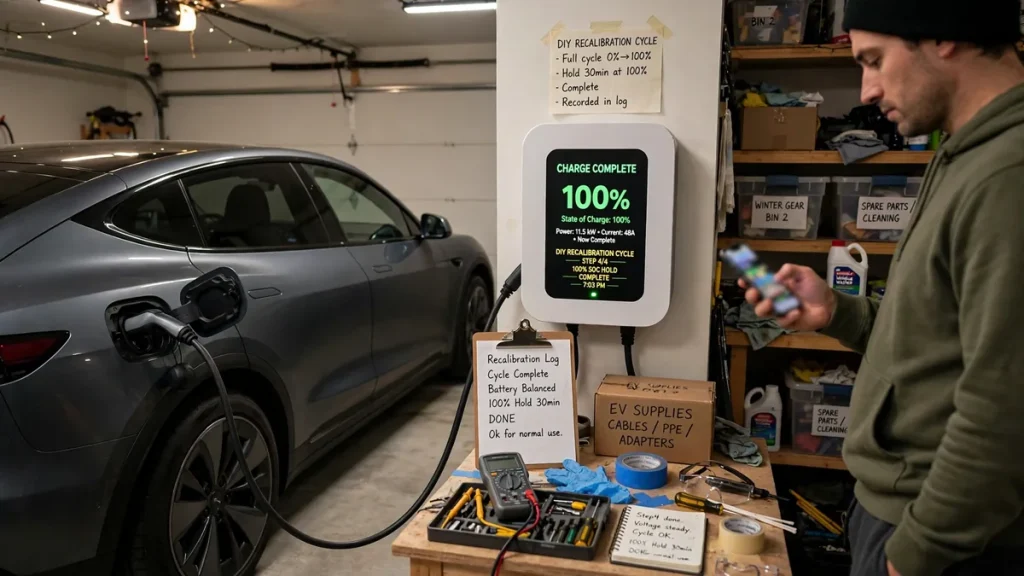
This is the most accessible form of reconditioning and should be the first step before any paid service:
- Drive the battery to 10–15% SOC
- Connect to Level 2 and charge to 100%
- Leave plugged in for 1 hour after reaching 100% (allows passive cell balancing)
- Drive 50–100 miles normally
- Repeat 2–3 times
This recalibrates the BMS and allows the passive balancing system to equalize cells. It costs nothing and often recovers 2–5% of displayed range on batteries where calibration drift was the primary issue.
Type 2: Professional EV battery reconditioning ($300–$800)
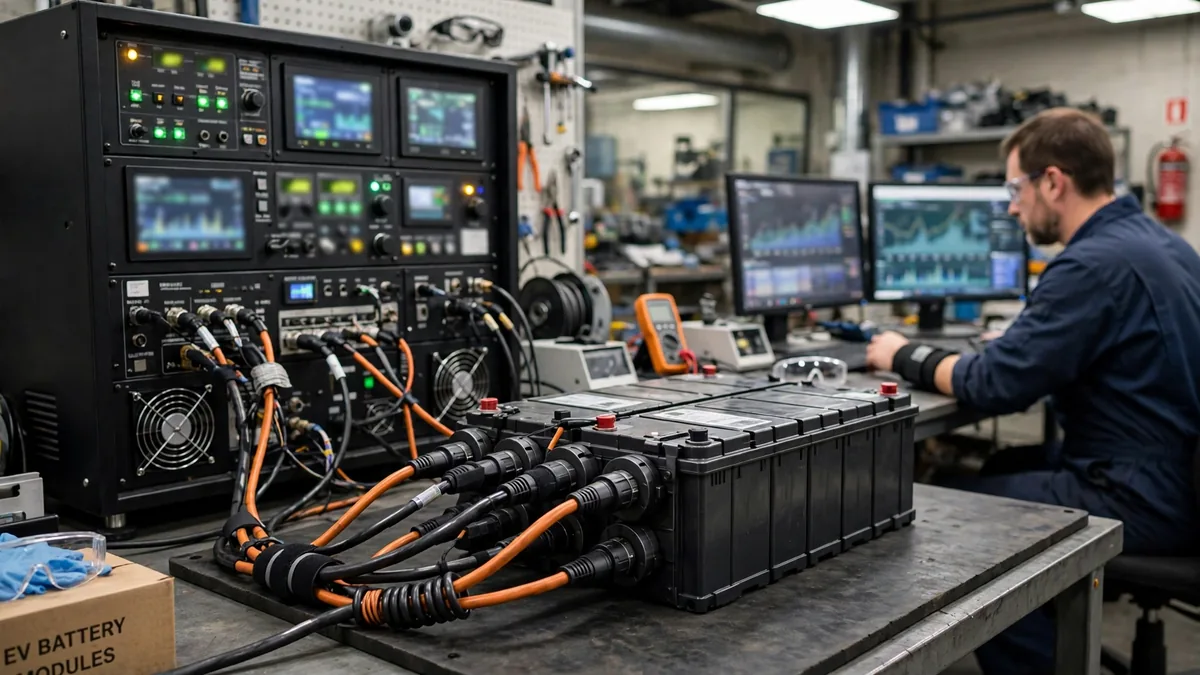
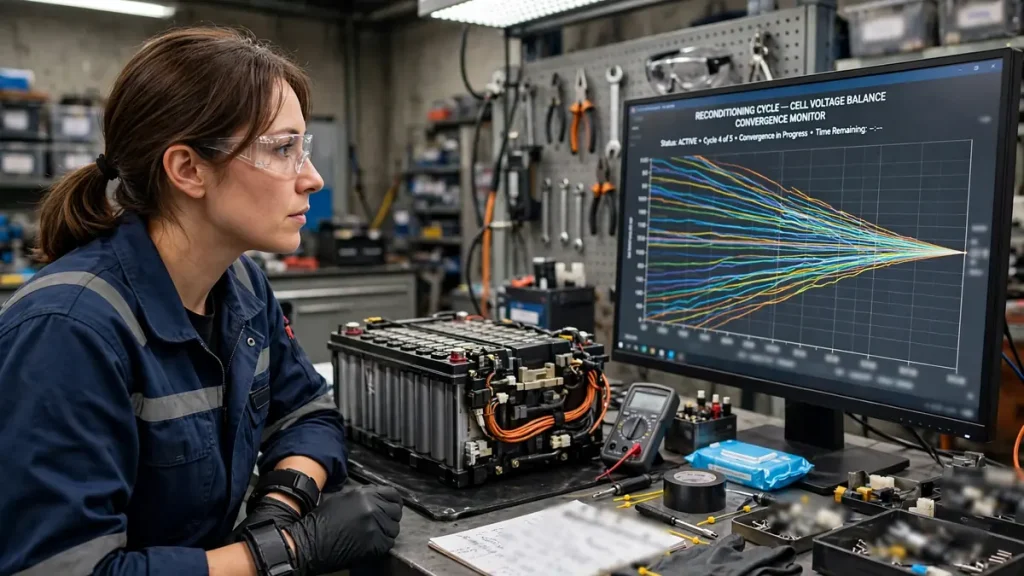
Third-party EV shops offer professional reconditioning services that use external battery cycling equipment and specialized chargers. The process typically involves:
- Multiple controlled discharge cycles to specific depth-of-discharge levels
- Slow-rate charging at specific current levels designed to equalize cells more aggressively than the BMS’s passive balancing
- Extended hold periods at specific SOC levels
- BMS data monitoring throughout to track cell voltage convergence
According to my experience, professional reconditioning produces meaningful improvements (5–10% range recovery) in batteries where cell imbalance and calibration drift account for a significant portion of the apparent capacity loss. On batteries with genuine chemical degradation, results are much more limited (1–3% at best).
Type 3: Dealer “battery conditioning” procedures
Some manufacturers offer dealer-performed battery conditioning procedures, using OEM diagnostic tools to run controlled charge cycles with the BMS in a service mode that allows more aggressive balancing than normal operation permits. Results vary by manufacturer and vehicle age. These are most effective on batteries that haven’t been deeply degraded chemically.
When Reconditioning Is Worth Trying
| Situation | Reconditioning Likely Helps? | Why |
|---|---|---|
| BMS calibration drifted (routinely charged 20–80%) | Yes, try DIY first | Recalibration recovers displayed range |
| Cell voltage spread of 50–100 mV | Yes, professional conditioning | Balancing may converge the spread |
| Sudden range drop after a single event | Possibly, try DIY first | May be calibration; if persists, hardware |
| Cell voltage spread of 200+ mV | Limited benefit | Severely degraded cells won’t equalize fully |
| SOH below 70% over high mileage | Minimal benefit | Chemical degradation is dominant |
| P3101 (Leaf) or confirmed cell failure code | No | Module replacement needed |
Brand-Specific Reconditioning Notes
- Nissan Leaf: Reconditioning is most discussed for the Leaf due to its rapid passive cooling-driven degradation. LeafSpy’s Hx reading (battery resistance health) is the key metric, reconditioning helps most when Hx is above 60% and SOH is in the 70–85% range. Below those levels, cell replacement is more practical.
- Tesla: Tesla’s BMS performs sophisticated self-balancing. DIY recalibration cycles are the primary reconditioning approach. Tesla service can perform additional conditioning procedures through service mode access not available to third-party tools.
- Chevy Bolt: Car Scanner + OBDLink MX+ reading before and after reconditioning provides quantifiable before/after comparison to evaluate results. See our guide on why Chevy Bolt battery health decreases for Bolt-specific degradation patterns.
- Hyundai Ioniq 5 / Kia EV6: Limited reconditioning options compared to older EVs. DIY recalibration cycles are the primary accessible option.
FAQs
Will reconditioning recover my Nissan Leaf from 75% SOH to 85%?
It’s unlikely reconditioning will recover a full 10 percentage points of genuine capacity loss. If the 75% SOH reflects actual cell degradation, reconditioning may recover 2–4% at most, bringing the display to 77–79% rather than 85%. If the 75% SOH includes significant BMS calibration drift, a recalibration cycle alone might show 79–82%. A professional reconditioning service should assess your Leaf’s Hx reading before committing to the service, if Hx is below 65%, the potential recovery from reconditioning is limited. If the bars on your dashboard have dropped to zero, see our specific guide on what zero capacity bars means on a Nissan Leaf.
For a related problem, see Diagnosing EV Battery Cell Imbalance: Step-by-Step Guide.
How long does the benefit of reconditioning last?
BMS recalibration benefit lasts until the BMS’s model drifts again, which happens gradually with continued charging in a narrow SOC range. Running a full recalibration cycle (10% → 100%) once per month maintains calibration accuracy. Cell balancing from professional reconditioning is more durable, cells that were equalized stay closer to balanced as long as the underlying cells remain healthy.
Conclusion
EV battery reconditioning genuinely helps with BMS calibration drift and mild cell imbalance, recovering 3–8% of displayed range in favorable cases. It cannot reverse chemical cell degradation. Always try the free DIY recalibration cycle first. If significant improvement occurs, the battery had calibration drift as a primary issue. If little improvement occurs, the capacity loss is from genuine cell chemistry degradation and module replacement is the appropriate next step. For Nissan Leaf owners specifically, reconditioning is worth exploring before committing to replacement costs, but set expectations based on the LeafSpy Hx reading.