How to Stop EV Battery From Draining When Camping


You’re camping in your EV, using it as a power source for lights, climate, and maybe appliances, and you’re concerned about the battery draining overnight or over a multi-day trip. Managing EV battery drain while camping requires understanding exactly how much power different features use and how to balance comfort with energy conservation. This guide gives you everything you need for successful EV camping.
This guide belongs to our EV battery drain and energy loss section. For the full overview, see Why Is My EV Battery Draining Overnight.
The Short Answer
Climate control is the primary battery drain while camping in an EV. Running the heater all night in cold weather costs 15–30% of the battery per night. Running A/C in extreme heat costs a similar amount. The most effective strategies to stop EV battery drain while camping are: minimizing climate use through proper insulation and shade, using the EV’s most efficient heating mode (not max heat), camping where Level 2 charging is available, and using the EV’s Camp Mode or similar feature to maintain a stable low-power mode overnight. See our full guides on EV heater battery drain and EV A/C battery drain for the exact power costs of each climate feature.
EV Camping Power Consumption: What Uses the Most Energy
| Feature | Power Draw | Battery Drain Per 8 Hours |
|---|---|---|
| Cabin heater (cold night below 32°F) | 2–4 kW average | 16–32 kWh (20–40% of 75 kWh pack) |
| Heat pump heating (mild cold) | 0.8–1.5 kW average | 6–12 kWh (8–16% of pack) |
| A/C (hot night above 90°F) | 1.5–3 kW average | 12–24 kWh (16–32% of pack) |
| Heated seats (both front, high) | 0.2–0.3 kW | 1.6–2.4 kWh (2–3%) |
| Interior lighting | 0.05–0.1 kW | 0.4–0.8 kWh (0.5–1%) |
| Pro Power Onboard / V2C outlets | Depends on load | Varies, 1 kW load = 8 kWh overnight |
| Connected services (cellular/GPS) | 0.02–0.05 kW | 0.2–0.4 kWh (0.3%) |
Camp Mode: What It Does and Which EVs Have It
Tesla Camp Mode
Tesla’s Camp Mode maintains cabin temperature, interior lighting, and music while the car is in Park, without shutting down climate after inactivity. It’s designed specifically for overnight car camping. To enable: tap the fan icon → select “Camp.” The car maintains the climate at your set temperature through the night. Note: Camp Mode does not disable Sentry Mode, if Sentry is on while in Camp Mode, the combined drain is significant. Disable Sentry Mode when using Camp Mode to conserve battery. See our dedicated Sentry Mode drain guide for the exact hourly cost.
Ford F-150 Lightning Pro Power Onboard
The Lightning’s Pro Power Onboard system provides up to 9.6 kW of 120V/240V outlets for running external devices, appliances, or tools from the truck bed and cabin. This is the most powerful in-vehicle power export available on a production EV. For camping, the Lightning can run external heaters, small appliances, or power tools directly from its battery. Power draw depends entirely on what’s plugged in, plan accordingly and monitor battery level.
Rivian Camp Mode
Rivian offers Camp Connect, an integrated camp power mode with configurable climate, lighting (interior and exterior), and gear tunnel outlets. The Rivian app provides battery consumption tracking during camp mode. Rivian’s Camp Courtesy Mode dims exterior lights and reduces alarm sensitivity to avoid disturbing nearby campers.
Hyundai Ioniq 5 / Kia EV6 Vehicle-to-Load (V2L)
The Ioniq 5 and EV6 include a Vehicle-to-Load (V2L) adapter that plugs into the charge port and provides a 120V/15A outlet, up to 1.8 kW of power for external devices. This is enough to run a small heater, fan, laptop, or camping gear. The EV6 GT supports the same feature. V2L draw comes directly from the HV battery, budget accordingly.
How to Stop EV Battery From Draining While Camping
Strategy 1: Minimize climate use: the biggest drain source
Cold weather camping:
- Use quality sleeping bags rated for the expected temperature, zero climate use if sleeping bag temperature rating covers the overnight low
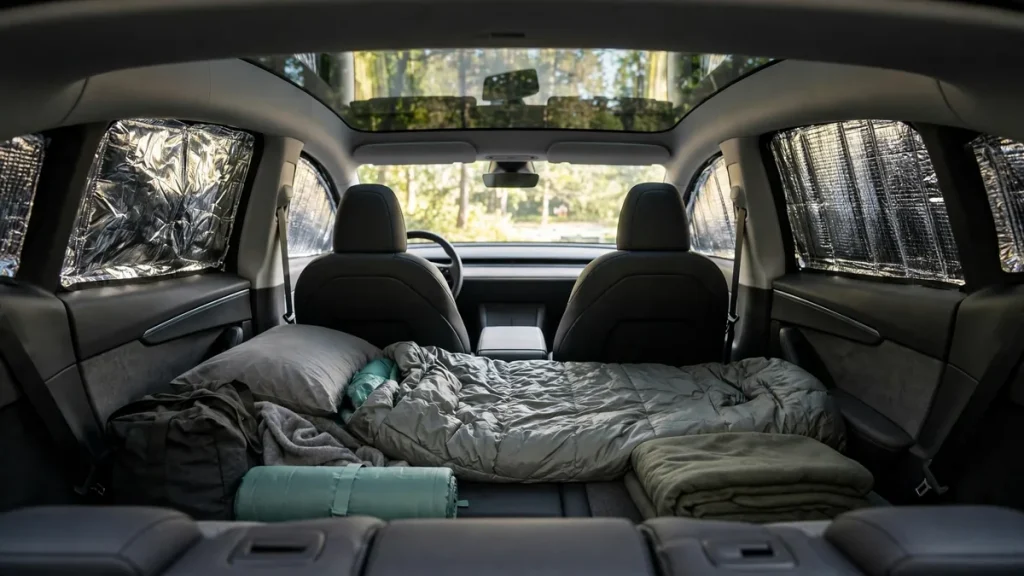
- Insulate the car, window covers and windshield insulation dramatically reduce heat loss, allowing the cabin heater to do less work to maintain temperature
- Set climate to the lowest acceptable temperature (60°F) rather than a comfortable 70°F, saves 30–40% of heating energy
- Use heated seats on low instead of cabin heat for metabolic warmth during awake hours
Hot weather camping:
- Park in shade, a shaded car is 30–50°F cooler inside, dramatically reducing A/C load
- Use window reflectors during daytime to prevent solar heat gain
- Set A/C target temperature to 72–74°F rather than 68°F, a 4°F difference saves 20–30% of A/C energy
- Run the fan at lower speed, the blower itself is a significant component of total A/C power
Strategy 2: Disable security monitoring
Sentry Mode, Guard Mode, or other active security monitoring draws 150–300W continuously while you sleep (roughly 5–10 miles of range over a full night). For secure campground camping where security risk is low, disable security monitoring entirely for the night. The savings are substantial, roughly 2–3% of battery per night that you’d otherwise lose to cameras watching trees.
Strategy 3: Charge where available
Many campgrounds, RV parks, and state parks now offer EV charging, either dedicated EVSE units or RV-standard 30A and 50A outlets that EVs can use with an adapter. Even a 30A/240V RV outlet (7.2 kW) offsets any camping power draw many times over. Plan campsite selection to include charging availability when possible for multi-night stays.

Strategy 4: Budget and monitor battery level
Know your overnight drain expectation before sleeping. If you need 150 miles of range for tomorrow’s drive and you’re starting the night with 200 miles, and overnight camping will cost 30 miles in heat use, you’ll wake with approximately 170 miles. If climate use might cost 50 miles overnight, start the evening with enough reserve. Set a low-battery alert in the companion app to wake you if drain exceeds expectations. For general benchmarks on what’s normal vs. excessive, see our guide on how much battery an EV should drain when parked.
Strategy 5: Use V2L or Pro Power for external efficiency gains
An external fan powered by V2L in summer (50–100W) is far more energy-efficient than running the car’s A/C compressor (2–3 kW) for the same cooling benefit in moderate temperatures. Similarly, a small external ceramic heater (750W) on Pro Power Onboard draws less than the car’s cabin heater in mild cold. Using external appliances optimized for efficiency can dramatically reduce overall battery camping drain.
EV Camping Battery Budget: Planning Guide
- Night 1 (tomorrow’s drive 100 miles): Need at least 100 miles’ worth of charge for driving. If camping costs 25–40 miles overnight, start the night with at least 140 miles remaining.
- Multi-night trip: Plan charging at least every 1–2 nights if climate is active. Most campgrounds with EV chargers allow charging during your stay for a per-kWh fee.
- Emergency reserve: Always maintain at least 20% battery as a reserve, enough to reach the nearest charging location if camping drain exceeds estimates.
FAQs
Can I safely sleep in my EV overnight with the heat or A/C running?
Yes, EVs produce no combustion gases, so there’s no carbon monoxide risk from sleeping inside with climate running. EV camping with the car sealed and climate on is safe from a fume perspective. Ensure the cabin has adequate fresh air exchange for occupant CO2, use the fresh air setting or crack a window slightly during long occupancy. Run climate in recirculation mode for efficiency but switch to fresh air periodically.
How many nights can a Tesla Model Y camp on a full battery?
With moderate climate (65°F target in cold weather, heat pump active), a Tesla Model Y’s 75 kWh battery can support approximately 2–3 nights of camping before reaching 20% reserve, assuming 6–10 kWh per night for heat pump heating in temperatures down to 35°F. In extreme cold or with A/C in hot weather, budget 15–25 kWh per night, reducing camping nights to 2 before the 20% reserve threshold.
Conclusion
Stopping EV battery drain while camping comes down to managing climate consumption, the largest drain by far. Use sleeping bags and window insulation to reduce climate load. Set climate targets to the minimum comfortable level. Disable security monitoring overnight. Charge where available. For EVs with V2L or Pro Power Onboard, external appliances optimized for efficiency can reduce total camping draw noticeably. Plan your battery budget before sleeping so you wake with the range you need for tomorrow’s drive.