Audi e-tron Battery Problems: What Owners Say

The Audi e-tron (now marketed as the Audi Q8 e-tron) was Audi’s first mass-market electric vehicle, launching in 2019. As one of the earliest premium EVs from a traditional luxury automaker, it has developed a specific set of known battery issues over years of real-world ownership. This guide covers every significant Audi e-tron battery problem owners report and what to do about each one.
Quick Answer
The Audi e-tron’s most commonly reported battery problems are a DC fast-charging rate significantly below the advertised 150 kW in real-world conditions (due to temperature requirements and SOC taper), below-expected range (especially in cold weather and at highway speeds), and occasional 12V battery failures that cause cascading warning lights. The e-tron’s charging rate is notably sensitive to battery temperature — preconditioning with the Audi MMI navigation is essential for consistent fast charging performance.
Audi e-tron Battery Overview
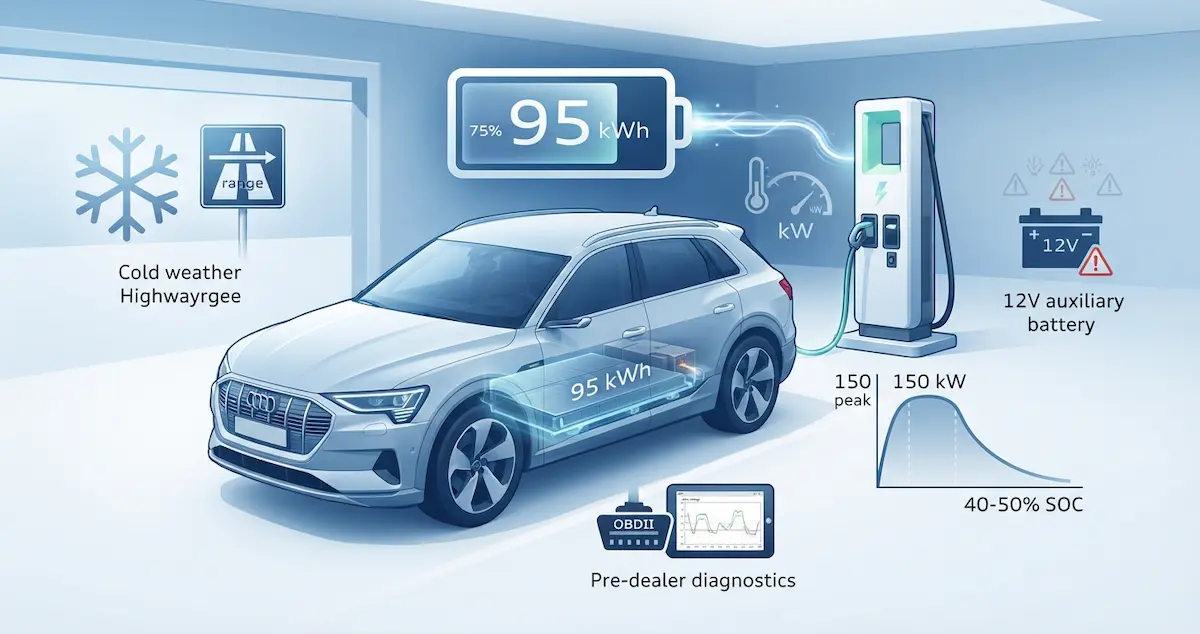
The Audi e-tron uses a 95 kWh battery (86.5 kWh usable on most variants). The e-tron Sportback shares the same battery. The 2022+ Q8 e-tron uses an updated 114 kWh (104 kWh usable) battery. DC fast charging peaks at 150 kW (original e-tron) or 170 kW (Q8 e-tron). Level 2 home charging is standard at 11 kW; 22 kW is available with the optional upgraded onboard charger. The e-tron uses a 400V architecture — a standard it shares with the VW Group’s MEB platform, though the e-tron itself predates MEB.
Most Common Audi e-tron Battery Problems
Problem 1: DC fast charging rate well below 150 kW
The e-tron’s 150 kW peak DC fast charge rate is achievable only under specific conditions. In real-world owner experience, the average charging rate over a typical 20–80% session is often 80–110 kW — not 150 kW. This is because:
- Temperature sensitivity: The e-tron’s peak rate requires battery temperature above approximately 77°F. Below this, the rate is significantly reduced — sometimes to 40–60 kW at cold starts.
- SOC taper: The 150 kW peak is maintained only until approximately 40–50% SOC. Above this, the rate tapers progressively.
- No navigation-triggered preconditioning on older software: Early e-tron builds didn’t actively precondition the battery en route to a DC charger. This was improved on later software updates and on the Q8 e-tron.
Use the Audi MMI’s built-in navigation (not Apple CarPlay) to route to the charging station — this activates any preconditioning supported by the specific software version. Arrive with the battery below 40% for the longest time at peak rate.
Problem 2: Below-expected real-world range
The Audi e-tron has been consistently flagged in real-world testing as having a larger gap between EPA-estimated range and actual range than most competitors. Contributing factors:
- High drag coefficient: The original e-tron was designed as an SUV first and aerodynamics second — its drag coefficient is higher than purpose-built EVs like the Tesla Model Y, which significantly impacts highway efficiency
- Heavy weight: At approximately 5,600 lbs, the e-tron is heavier than most competitors, which increases energy consumption, particularly in stop-and-go driving and hill climbing
- Cold weather impact: Below 32°F, expect 25–35% range reduction; the e-tron’s range in winter climates is frequently cited as a significant real-world limitation
If range is within 20–25% of the EPA estimate in normal driving conditions, this is real-world normal for the e-tron. If range is more than 30% below the EPA estimate in mild weather without unusual conditions, get an OBD2 scan for battery fault codes and assess actual battery health using a Volkswagen Group-compatible OBD2 scanner.
Problem 3: 12V auxiliary battery failure
Like several other EVs from the same period, the Audi e-tron has experienced above-average 12V auxiliary battery failure rates, particularly in vehicles produced in 2019–2021. When the 12V battery fails, it triggers multiple simultaneous warning lights — often including battery, stability control, parking assist, and other systems — that can look alarming but are typically due to a dead 12V battery. Test the 12V before pursuing any high-voltage diagnosis. Replacement uses a specific AGM unit available through Audi dealers or aftermarket suppliers.
Problem 4: “Battery Charging Fault” or charging error messages
Some e-tron owners have reported DC fast charging failures — sessions that won’t initiate or stop prematurely. Common causes:
- Cold battery (below 50°F) — rate is severely restricted, or the session doesn’t initiate on some CCS configurations
- CCS station compatibility issue — try a different stall or network
- Outdated vehicle software — Audi has pushed MMI updates improving CCS compatibility
- Genuine onboard DC charging module fault — requires dealer ODIS diagnosis
The OBDeleven (OBD11) app with a compatible adapter provides the most accessible Audi-specific pre-dealer diagnostics for the e-tron, reading fault codes from the BMS and charging modules that generic OBD2 apps miss.
Problem 5: High-voltage battery capacity loss over time
Early Audi e-tron owners (2019–2020 models with 3–5 years of use) report varying rates of degradation. The e-tron’s active liquid cooling provides good thermal management — owners in hot climates have generally seen better longevity than Nissan Leaf owners in comparable conditions. Real-world degradation of 8–12% after 3–4 years of mixed use is within normal parameters for this battery chemistry. Higher degradation rates in hot climates or with frequent DC fast charging are consistent with the stress-related degradation patterns seen across all lithium batteries.
Problem 6: Software-related warnings on 2019–2021 builds
Early e-tron software had several documented BMS calibration and communication issues that generated warnings on healthy vehicles. Audi pushed multiple software updates through the MMI OTA system (and at dealer service visits on older builds) that addressed many of these. If experiencing advisory battery warnings on an early e-tron, check the software version and update history before pursuing hardware diagnosis.
Audi e-tron Battery Warranty
Audi covers the e-tron and Q8 e-tron high-voltage battery under the 8-year/100,000-mile federal battery warranty. This covers defects and capacity loss below the stated minimum threshold (70% of original capacity). Audi also includes the e-tron in Electrify America’s charging benefit — complimentary 30-minute sessions during the ownership period. Document all battery warnings with date, mileage, MMI warning text, and software version for warranty claim purposes.
Diagnostic Tools for Audi e-tron Battery Issues
- OBDeleven (OBD11): Best accessible Audi-specific diagnostic tool — reads e-tron BMS fault codes, charging module data, and cell group voltages. Requires the OBDeleven Pro adapter.
- ODIS (dealer tool): Audi’s authoritative diagnostic software — only at Audi dealers but provides the most complete e-tron battery diagnosis.
- Car Scanner ELM OBD2: Reads standard OBD2 fault codes; less comprehensive on VW Group-specific battery modules but useful for initial code reading.
Conclusion
The Audi e-tron’s battery problems are well understood after years of real-world ownership: charging rates below 150 kW peak due to temperature requirements and SOC taper, below-class-average highway range due to aerodynamics and weight, and 12V battery failures that cause cascading warnings. Most charging performance improvements require preconditioning through MMI navigation, current software, and arriving at DC chargers with low SOC. Genuine hardware faults — persistent charging failures and confirmed cell-voltage faults — are covered under the 8-year/100,000-mile warranty. Use OBDeleven for pre-dealer diagnostics before any dealer appointment.