
How Often Does the 12V Battery Die in an EV?

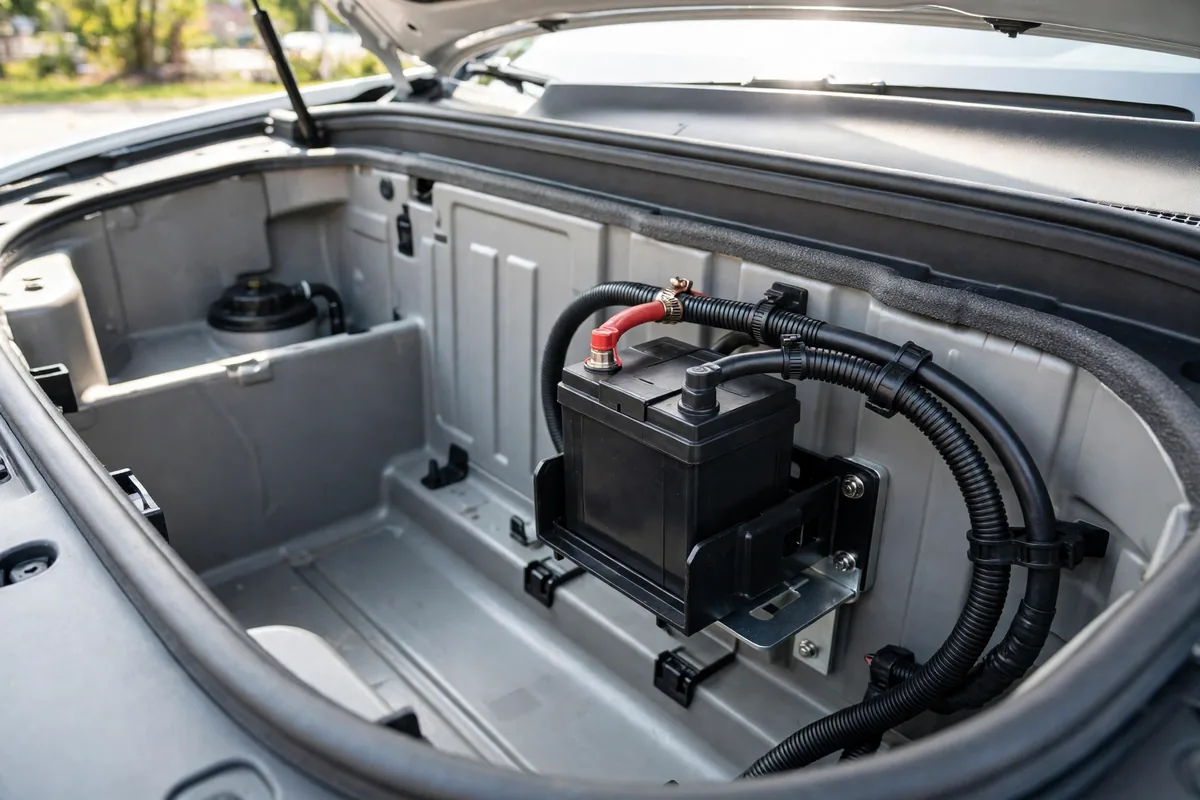
If you own an EV long enough, the 12V auxiliary battery will eventually die. Knowing how often this happens, and when to expect it, lets you replace it proactively before it ever strands you. This guide covers typical 12V battery lifespan across EV brands, signs it’s failing, and how to extend its life.
This guide belongs to our EV won’t start or power on section. For the full overview, see What to Do If Your EV Won’t Power On.
In Short
The 12V battery in most EVs lasts 3–5 years before it needs replacement. EVs are actually harder on 12V batteries than gas cars because of constant background current drain from always-on systems. Most owners experience their first 12V failure between years 3 and 5. Proactively replacing it at year 4 avoids being stranded.
Why 12V Batteries Die Faster in EVs Than Gas Cars
In a gas car, the engine runs regularly and the alternator keeps the 12V battery fully charged. The battery only really works hard during starting, then recovers immediately.
In an EV, the 12V battery works differently:
- The car never truly “sleeps”, cellular modems, alarm systems, Bluetooth, and BMS background processes draw current 24/7
- The DC-DC converter (which charges the 12V from the main pack) only runs when the car is on or plugged in, not when the car sits unplugged
- High-drain features like Sentry Mode (Tesla) or always-on cameras add noticeably to standby drain
- Many EVs have software sleep mode bugs that keep systems running longer than they should
The result: EV 12V batteries experience more discharge cycles and shallower recovery compared to gas car batteries, which accelerates degradation.
How Often the 12V Battery Dies by Brand
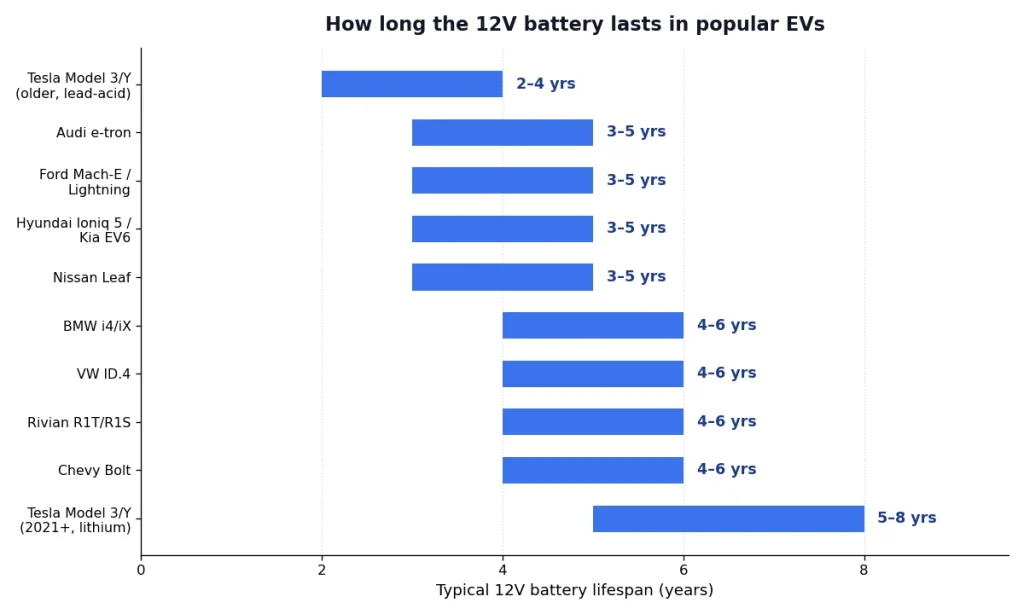
| Brand / Model | Typical 12V Battery Life | Notes |
|---|---|---|
| Tesla Model 3 / Y (older) | 2–4 years | Lead-acid 12V; known for higher drain. Newer models use lithium 12V. |
| Tesla Model 3 / Y (2021+) | 5–8 years | Lithium 12V battery, noticeably longer-lived |
| Tesla Model S / X | 2–4 years | High vampire drain historically; software updates improved this |
| Nissan Leaf | 3–5 years | 12V drains faster when not plugged in due to limited sleep optimization |
| Chevy Bolt EV / EUV | 4–6 years | Generally reliable 12V; software updates improved sleep behavior |
| Hyundai Ioniq 5 / Kia EV6 | 3–5 years | 12V drain reported when not plugged in for extended periods |
| Ford Mustang Mach-E | 3–5 years | FordPass app activity can increase standby drain |
| Ford F-150 Lightning | 3–5 years | Alexa integration increases standby current |
| Rivian R1T / R1S | 4–6 years | Good sleep mode implementation; OTA updates improved drain |
| VW ID.4 | 4–6 years | Generally solid; check for software updates if experiencing drain |
| BMW i4 / iX | 4–6 years | BMW uses a lithium 12V in some trims, longer lifespan |
| Audi e-tron | 3–5 years | Known to drain faster; keep plugged in when possible |
| Polestar 2 | 4–5 years | Software updates addressed sleep mode; keep updated |
Signs Your 12V Battery Is Getting Close to Dying
Don’t wait for the battery to die completely. These signs usually appear weeks or months before total failure:
- The car’s app frequently shows the car as offline when it shouldn’t be
- Door locks, windows, or mirrors respond slowly
- A “12V Battery Low” or “12V Battery Service Required” warning appears in the app or dashboard
- The car needed a jump start once already
- Headlights seem dimmer than they used to
- The dashboard takes longer to appear when you get in
- The car is between 3 and 6 years old and has never had the 12V battery replaced
How to Check Your 12V Battery Health
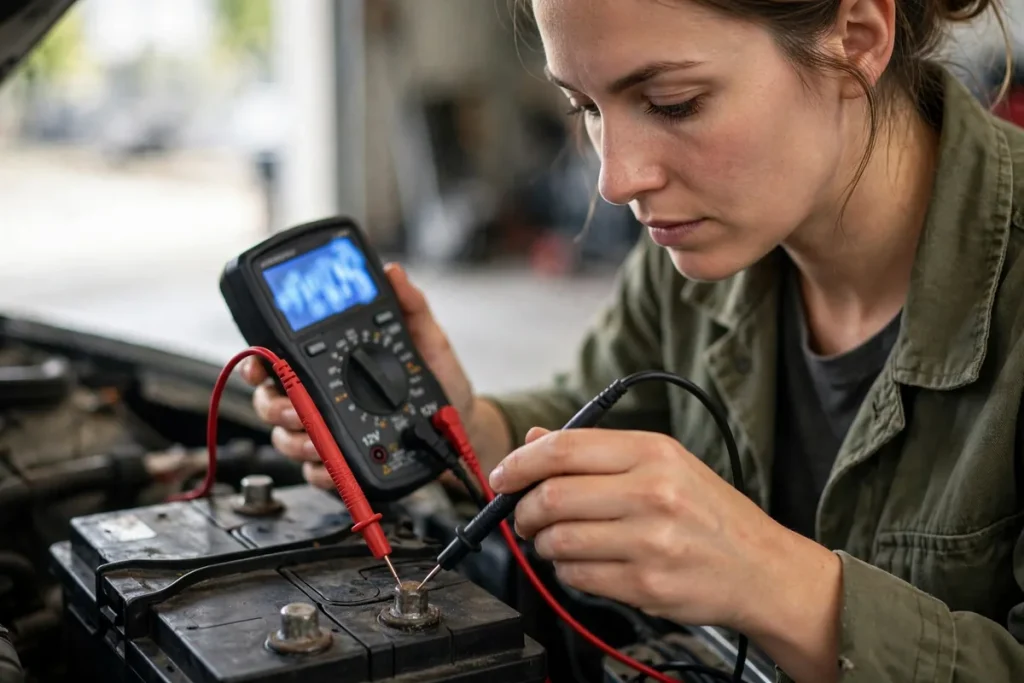
A basic multimeter test takes 60 seconds. With the car off, check the voltage across the 12V terminals:
For a related problem, see What to Do If You’re Stranded With a Dead EV Battery.
- 12.6V+: Healthy
- 12.4–12.6V: Okay, monitor it
- 12.0–12.4V: Weak, plan to replace soon
- Below 12.0V: Replace immediately
You can also have the battery load-tested at most auto parts stores for free. A load test checks whether the battery can sustain voltage under actual current demand, more accurate than a static voltage reading.
When to Replace Proactively
According to my experience, replacing the 12V battery at 4 years old, before it fails, is the best policy for most EV owners. The replacement costs $80–$200 for the battery and is often a DIY job. This is a small price compared to being stranded in a parking lot or away from home, especially since 12V failures rarely come with much warning.
If your car regularly sits unplugged for several days at a time, consider replacing at 3 years instead of 4.
How to Make the 12V Battery Last Longer
- Always plug in when home, even if you don’t need to charge the main battery. This allows the DC-DC converter to maintain the 12V battery from the main pack.
- Disable high-drain features when parked: Turn off Sentry Mode (Tesla), always-on cabin cameras, and other standby features you don’t need at home.
- Keep software updated, sleep mode improvements and drain-reduction fixes come through OTA updates regularly.
- If storing long-term: Connect a 12V trickle charger (like a CTEK or Battery Tender) to the 12V terminals to maintain the battery during extended storage.
- Avoid extreme temperature storage, park in a garage if possible in very cold or very hot weather.
FAQs
Does plugging in the car every night really extend 12V battery life?
Yes, noticeably. When plugged in, the DC-DC converter actively maintains the 12V battery voltage. This prevents the deep partial discharges that cause cumulative battery degradation. EV owners who plug in every night consistently report longer 12V battery life than those who leave the car unplugged regularly.
My 12V battery died at 2 years old: is that normal?
Earlier than average, but it happens, especially with high-drain feature use, if the car sits unplugged for long periods, or if the factory battery was defective. If the car is under 3 years old (within the basic vehicle warranty), the replacement should be free. A 12V failure at 2 years is also worth investigating, check whether a software bug is causing excessive sleep drain.
Should I replace the 12V battery myself or go to a dealer?
Many EV owners replace the 12V battery themselves successfully. It doesn’t involve the high-voltage system at all. The main challenge is locating the battery (frunk on many models) and knowing the correct replacement specs. Look up a model-specific guide on YouTube first. If you’re not comfortable working around car electronics, a dealer or any auto parts store with a battery installation service can do it for $50–$150 in labor.
Conclusion
Plan to replace the 12V battery in your EV at 3–4 years old, don’t wait for it to fail. EVs demand more from the 12V battery than gas cars do, and the warning signs of imminent failure are easy to miss. Always plug in when home, disable unnecessary standby features, and keep your software updated. A $100–$200 proactive battery replacement beats being stranded far from home every time.