Can You Jump Start an Electric Car?

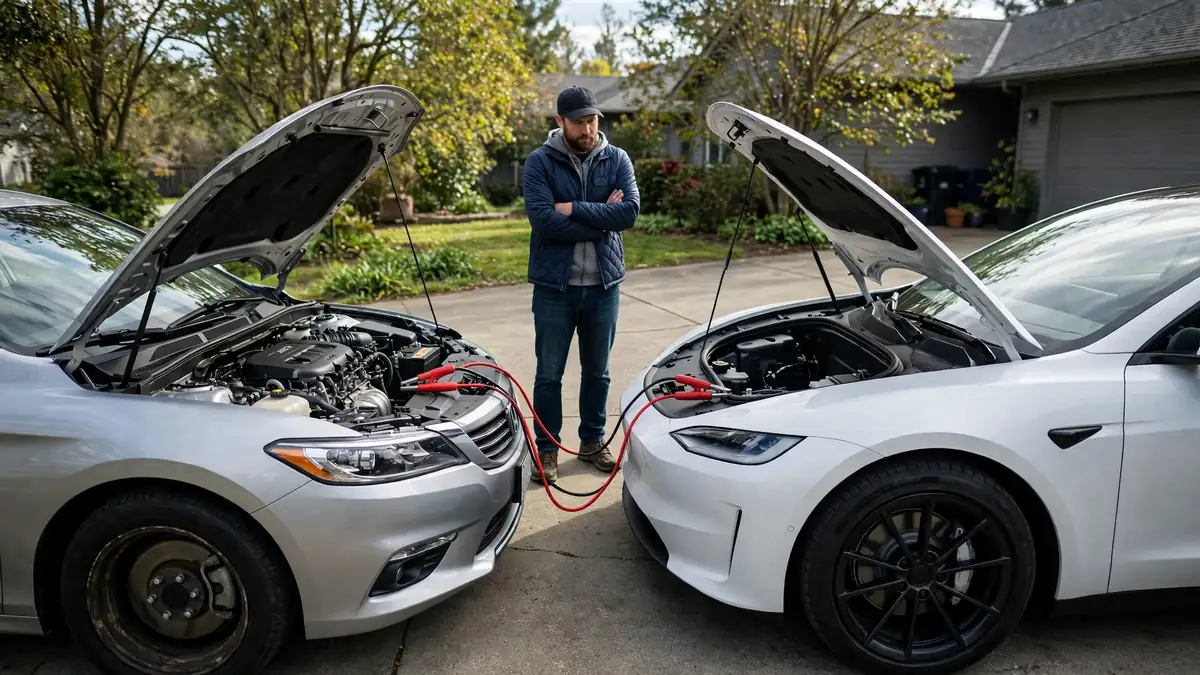
Yes, you can jump-start an electric car, but only in a specific way and only on the right battery. This guide answers every question about jump-starting an EV: whether it’s safe, how to do it correctly, and exactly what not to do.
This guide belongs to our EV won’t start or power on section. For the full overview, see What to Do If Your EV Won’t Power On.
Quick Answer
Yes, you can jump-start an EV, specifically, you can jump-start its 12V auxiliary battery, which is the same process as jump-starting a conventional car. You connect to the dedicated 12V terminals (found in the frunk or under the hood), not the main charging port. Never attempt to jump-start the main high-voltage battery pack, it carries 400–800 volts and doing so is extremely dangerous and would destroy electrical components.
The Important Distinction
When people ask “can you jump-start an electric car?”, they usually have the wrong battery in mind. EVs have two batteries:
- The main high-voltage battery (400–800V): Powers the motor. Never jump-start this, not with cables, not with anything. It’s a different technology entirely and requires specialist equipment.
- The 12V auxiliary battery: Powers the computers, displays, lights, locks, and the system that allows the main battery to work. This CAN be jump-started exactly like a regular car battery.
In almost every case where an EV “needs a jump start,” it’s the 12V battery that’s dead, not the main pack. The fix is simple, safe, and takes under 10 minutes.
Is It Safe to Jump-Start an Electric Car?
Yes, jump-starting the 12V auxiliary battery of an EV is safe when done correctly. Every major EV manufacturer, Tesla, Ford, Hyundai, Kia, Chevy, Nissan, Rivian, VW, BMW, Mercedes, Audi, Polestar, includes jump-start instructions in their owner’s manual. It is a documented, approved procedure.
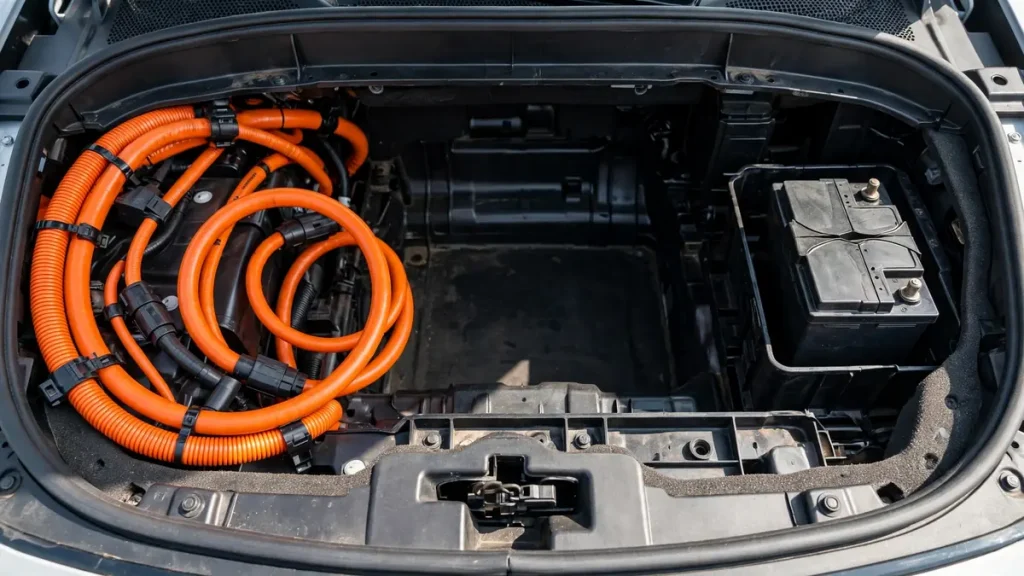
The only danger is connecting to the wrong terminals. If you accidentally touch the orange high-voltage cables or the main charging port, you are dealing with lethal voltage. As long as you only connect to the labeled 12V terminals, there is no risk to you or the car.
What You Need
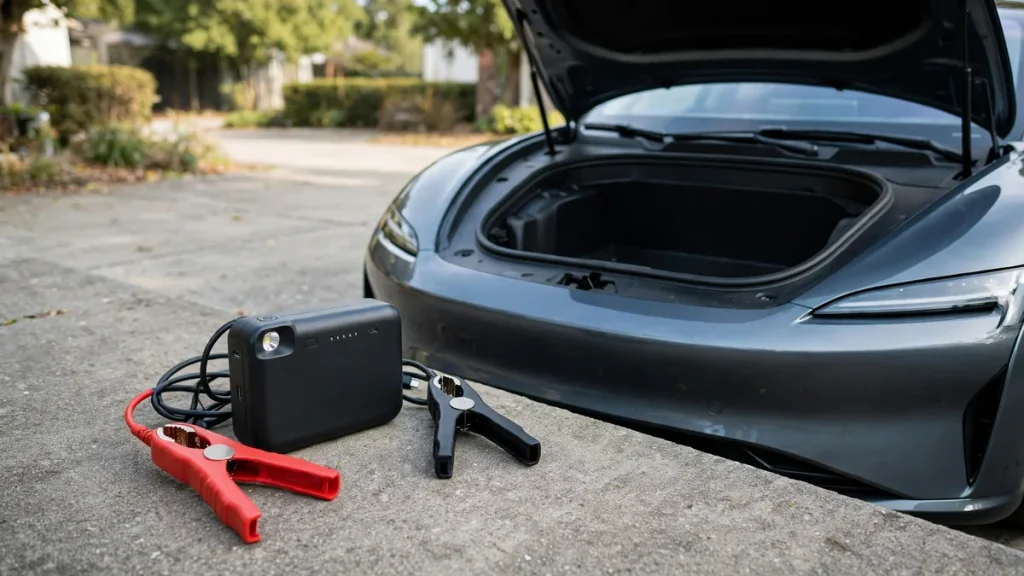
- Option A (recommended): A portable jump starter pack with 12V output, compact, no second vehicle needed, safe and easy to use
- Option B: Standard jumper cables and another vehicle with a 12V battery (gas car, hybrid, or another EV)
- Your owner’s manual to locate the exact 12V terminals on your specific model
What You Should NOT Do
- ❌ Never connect anything to the main charging port (the socket where you plug in the charging cable)
- ❌ Never touch or cut the orange high-voltage cables that run under the car
- ❌ Never try to “boost” the main battery pack with external power
- ❌ Never connect jumper cables reversed (positive to negative), this can destroy electronics
- ❌ Never use a high-amperage truck jump starter, EV 12V systems are sensitive; use a standard passenger car rated jump starter
Step-by-Step: How to Jump-Start an Electric Car
Step 1: Find the 12V jump-start terminals
Open your owner’s manual and locate the 12V jump-start procedure. Every EV has dedicated jump terminals, they are not in the same location as a regular car’s battery. Common locations by model:
For a related problem, see Why Won’t My Electric Car Turn On?.
- Tesla Model 3/Y: Inside the frunk, left side panel, a small snap-off cover reveals + and – terminals
- Tesla Model S/X: Under the front hood near the washer fluid reservoir
- Chevy Bolt: Under the hood, driver’s side near the fuse box
- Nissan Leaf: Under the hood, passenger side
- Hyundai Ioniq 5: Frunk, driver’s side under a protective cap
- Kia EV6: Under the hood, passenger side
- Ford Mach-E / F-150 Lightning: Under the hood, red + terminal clearly marked
- Rivian R1T/R1S: Front hood panel, passenger side
- VW ID.4: Under the hood in the fuse box area
- BMW i4: Under the hood, driver’s side
- Audi e-tron: Under the hood, passenger side, labeled
Step 2: Position the jump source
If using another vehicle, park it close enough for the cables to reach, but make sure the two cars are NOT touching. Turn off the rescue vehicle.
If using a portable jump starter, make sure it is charged and the clamps are not yet connected to each other.
Step 3: Connect the cables in the correct order
- Red clamp → dead EV’s positive (+) 12V terminal
- Red clamp → jump source’s positive (+) terminal
- Black clamp → jump source’s negative (–) terminal
- Black clamp → bare metal ground on the EV (NOT the negative 12V battery terminal, use a metal bracket, engine mount, or ground bolt on the chassis)
Grounding to a chassis metal point instead of the battery negative reduces spark risk near the battery. This is standard jump-start procedure for any car.
Step 4: Wait 2–3 minutes
Don’t try to start immediately. Give the EV’s electronics time to receive enough charge to boot up. You should see the dashboard display come to life within 1–2 minutes if the connection is correct.
Step 5: Start the EV
Press the brake pedal and press the Start button (or put your foot on the brake and shift to Drive on models without a start button). The car should power on normally. The main battery will show whatever charge level it was at before, it hasn’t changed.
Step 6: Disconnect cables in reverse order
- Black clamp from EV chassis ground
- Black clamp from jump source negative
- Red clamp from jump source positive
- Red clamp from EV positive terminal
Step 7: Drive to replace the 12V battery
A jump start is temporary. The 12V battery will drain again. Drive directly to a dealer or auto parts store to get the battery tested and replaced. Don’t turn the car off until you arrive, you may not be able to restart it without another jump start.
FAQs
Can I use a gas car to jump-start an EV?
Yes. A gas car’s 12V battery can jump-start an EV’s 12V battery. Do not start the gas car’s engine while jump-starting the EV, just use the battery voltage alone. Starting the engine creates voltage spikes that can harm the EV’s electronics.
Can jump-starting an EV damage it?
Not if done correctly with the right terminals. Using an oversized commercial jump pack or connecting to wrong points can cause electrical damage. Always use the manufacturer’s specified 12V jump terminals and a standard passenger-vehicle rated jump starter. Never exceed the EV’s 12V battery voltage specification.
Will the 12V battery recharge after a jump start while I’m driving?
To a limited extent. When an EV is running, the DC-DC converter (which takes high voltage from the main pack and steps it down to 12V) helps maintain and trickle-charge the 12V battery. However, a badly depleted or failing 12V battery won’t fully recover from this, replace it rather than depending on the DC-DC converter to keep it alive.
Conclusion
Yes, you can jump-start an electric car, just the 12V auxiliary battery, using the dedicated 12V terminals in the frunk or under the hood. It’s exactly the same process as jump-starting any other 12V battery. The key rules are simple: use the right terminals, connect in the right order, and never go near the high-voltage main battery or charging port. After a successful jump, drive straight to replace the 12V battery the same day.