
Why Won’t My EV Start After Being Parked for 2 Weeks?

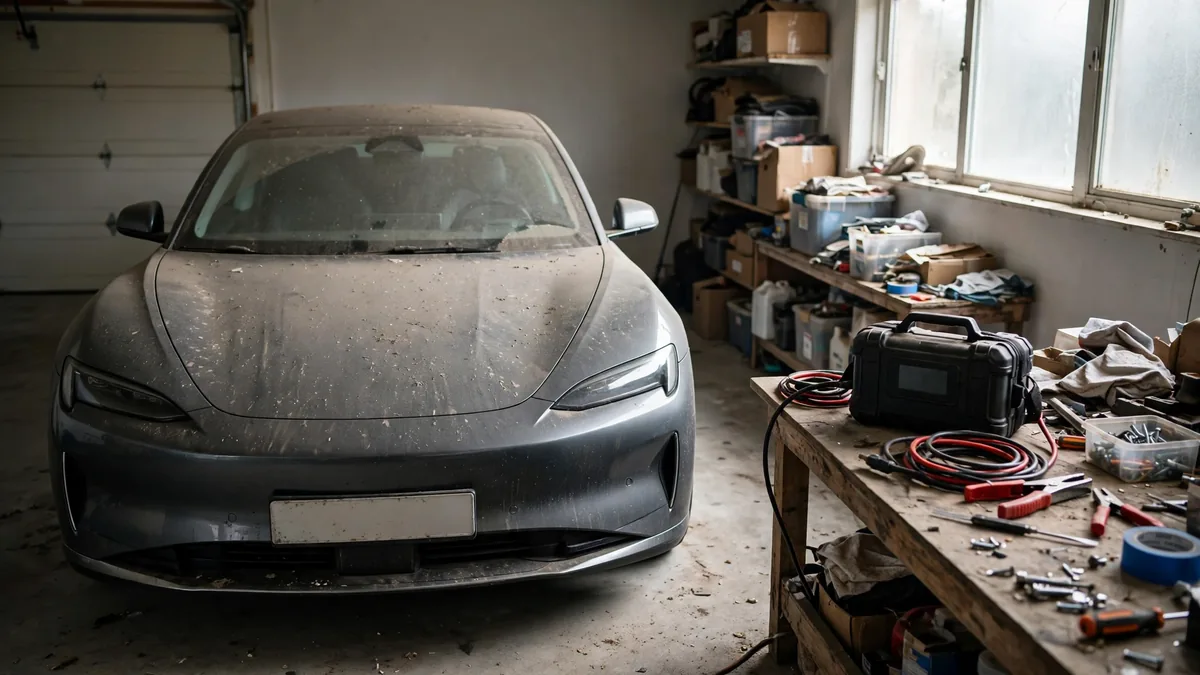
Your EV sat in the driveway, garage, or parking lot for two weeks, and now it won’t start. This is more common than people expect, and the cause is almost always predictable. This guide explains exactly what happens to an EV battery during extended parking and how to get the car running again.
This guide belongs to our EV won’t start or power on section. For the full overview, see What to Do If Your EV Won’t Power On.
What to Know First
An EV that won’t start after sitting for 2 weeks has almost certainly experienced 12V auxiliary battery drain. The 12V battery powers the computers and startup system, and EVs draw a small but constant current from it even when parked. After 2 weeks without being plugged in, a weak or aging 12V battery often can’t sustain enough charge to start the car. Jump-start the 12V terminals and replace the battery.
What Happens to an EV That Sits for 2 Weeks
Two things are happening simultaneously when an EV sits unplugged:
1. The 12V battery drains
The 12V auxiliary battery is being constantly depleted by background systems, cellular connectivity, alarm, Bluetooth presence detection, software watchdog processes. A healthy new 12V battery can handle 2–3 weeks of this drain. A battery that’s 3+ years old or already weakened may not make it 2 weeks. After two weeks unplugged, the 12V battery often drops to a voltage too low to boot the car’s electronics.
2. The main battery loses a small amount of charge
The main high-voltage battery also loses some charge from what’s called “vampire drain” or “passive discharge.” This is typically 0.5-2% per day for most EVs, meaning you could lose 7-28% of your main battery charge over 2 weeks — and far more if a feature like Sentry Mode stays on. This alone rarely prevents startup (unless the battery was already low) but it means you’ll have less range than you left with.
How to Diagnose Which Battery Is the Problem
- Car is completely dead, no lights, no response to key fob: 12V battery is dead. This is the most common scenario after 2 weeks unplugged.
- Car has partial power but won’t enter Ready mode: 12V battery is weak (not fully dead). Jump-starting or plugging in may restore enough voltage.
- Car powers on but shows very low main battery: Main battery drained during the 2 weeks. Plug in to charge.
- Car powers on but shows a fault code: The BMS may have entered a protection mode after the extended park. Try a soft reset first.
How to Fix It
Fix 1: Jump-start the 12V battery
This resolves the problem in the majority of cases. Locate the 12V jump terminals (frunk, under-hood fuse box, or dedicated jump point, check your owner’s manual) and connect a portable jump starter or cables from another vehicle. Connect red to positive (+), black to a chassis ground. Wait 3 minutes, then try to start the car.
Once the car starts, check the main battery level. Then drive to replace the 12V battery, it’s proven it can’t handle extended parking without support.
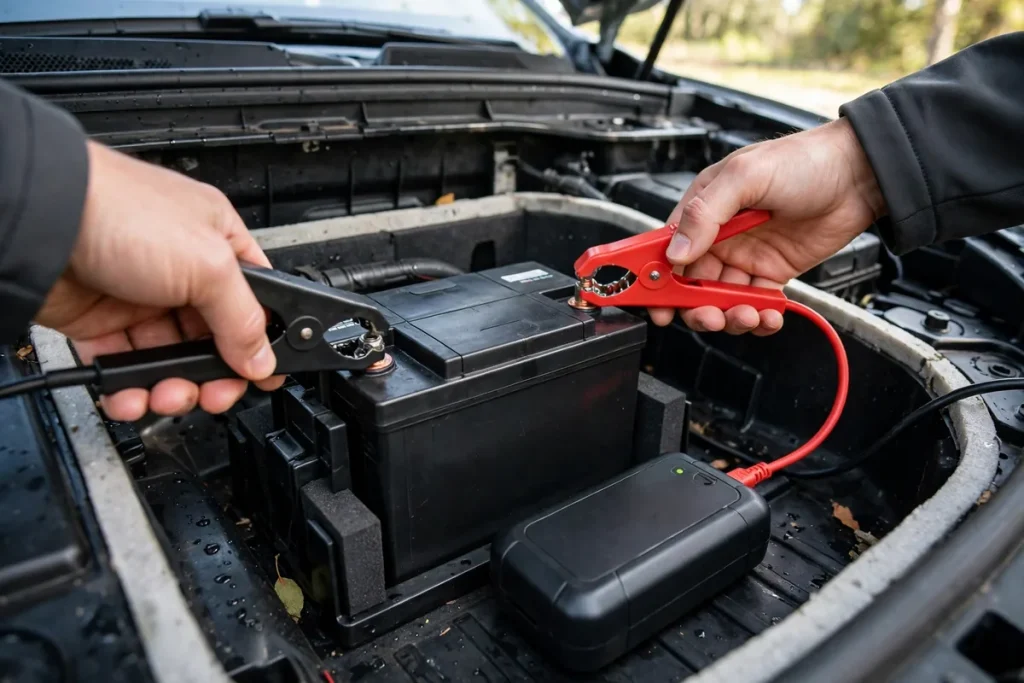
Fix 2: Plug in to charge both systems
If the car has enough 12V power to partially respond (frunk release works, app connects weakly), plug in the charging cable. Once plugged in, the DC-DC converter activates and begins charging the 12V battery from the main pack. This may restore enough 12V voltage to allow startup within 15–30 minutes without a jump start.
Fix 3: Soft reset after startup
After getting the car started (whether by jump start or charging), you may see warning lights or the car may show error messages. Perform a soft reset: turn the car fully off, open and close the driver’s door, wait 5 minutes, restart. Many BMS faults triggered by extended low-voltage parking clear with a reset and don’t recur once the battery is healthy.
How Much Charge Did the Main Battery Lose?
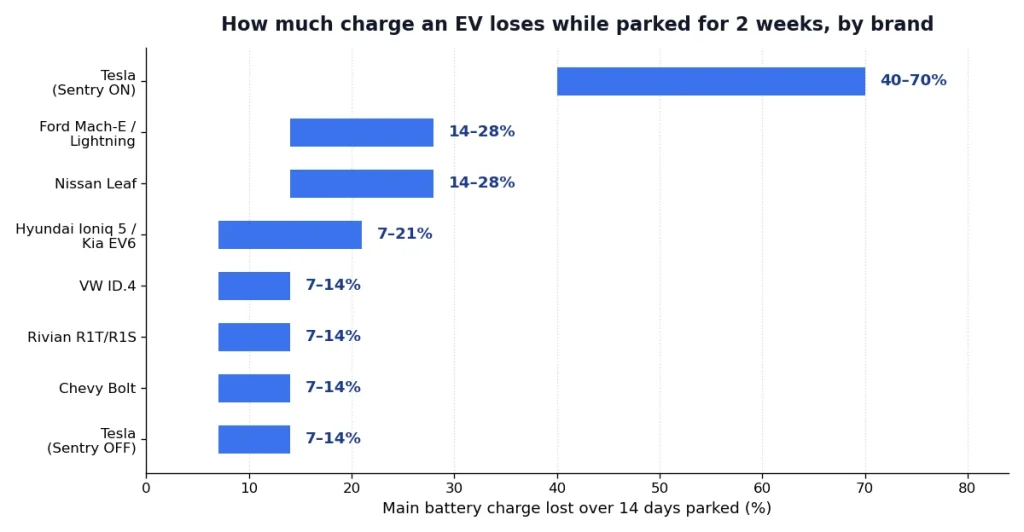
Typical vampire drain by brand over 2 weeks:
For a related problem, see How Often Does the 12V Battery Die in an EV?.
| Brand / Model | Approx. Drain per Day | Approx. Loss Over 14 Days |
|---|---|---|
| Tesla (Sentry Mode ON) | 3–5% | 40–70% |
| Tesla (Sentry Mode OFF) | 0.5–1% | 7–14% |
| Chevy Bolt | 0.5–1% | 7–14% |
| Nissan Leaf | 1–2% | 14–28% |
| Hyundai Ioniq 5 / Kia EV6 | 0.5–1.5% | 7–21% |
| Ford Mach-E / Lightning | 1–2% | 14–28% |
| Rivian R1T / R1S | 0.5–1% | 7–14% |
| VW ID.4 | 0.5–1% | 7–14% |
If the main battery has dropped noticeably (below 10%), charge it before attempting any long drive. And if you have a Tesla with Sentry Mode enabled and left it for 2 weeks, you may return to a nearly empty main battery regardless of what level you left it at.
Brand-Specific Behavior After Extended Parking
- Tesla: Enters deep sleep after several hours of inactivity (when Sentry Mode is off). Still drains 0.5–1% per day. If Sentry is on, drain is dramatically higher. Tesla’s newer models (2021+) with lithium 12V batteries handle extended parking much better.
- Nissan Leaf: Limited sleep optimization means higher standby drain. A Leaf left for 2 weeks unplugged is more likely to have 12V issues than most other brands.
- Chevy Bolt: Generally good sleep behavior. Main battery drain is minimal. 12V battery is the primary concern after extended parking.
- Ford Mach-E / Lightning: FordPass app activity can prevent deep sleep. Close the app on your phone before an extended absence.
- Rivian: Good sleep mode. Camp mode (if left on) will drain the battery faster, make sure camp mode is disabled before leaving for 2+ weeks.
How to Store an EV for 2+ Weeks Without Problems
- Leave it plugged in, this is by far the best option. The car maintains the 12V battery and keeps the main battery at its optimal storage level automatically.
- If plugged in isn’t possible, leave the main battery at 50–60% charge (not 100%, not empty) before parking
- Turn off Sentry Mode and other high-drain features before leaving
- Close all apps that communicate with the car on your phone, this reduces cellular wake-ups
- For storage beyond 2 weeks, connect a 12V trickle charger (like a CTEK MXS 5.0) to the 12V auxiliary terminals to maintain that battery independently
FAQs
Can 2 weeks of parking permanently damage the main EV battery?
Not from 2 weeks of normal parking. The main battery has protective chemistry that handles partial discharge without permanent harm. Leaving it at 0% for extended periods (months) can cause damage, but 2 weeks with a partial charge is generally fine for the main pack. The 12V auxiliary battery is far more vulnerable to extended parking than the main pack.
My car has been sitting for a month: is it too late?
Probably not. Try jump-starting the 12V terminals first. If the main battery still has some charge (even 10–20%), the car will likely start after the 12V is restored. If the main battery has also drained to near-zero, you’ll need to plug in and charge for an hour or two after the 12V jump before the car will operate. In rare cases where the main battery has sat at 0% for weeks, a dealer may need to perform a deep recovery charge procedure.
Conclusion
An EV that won’t start after 2 weeks of parking has almost certainly drained its 12V auxiliary battery. Jump-start the 12V terminals, get the car running, check the main battery level, and replace the 12V battery that same day. In the future, always leave the car plugged in during extended absences, even a Level 1 outlet keeps both batteries healthy indefinitely.