How to Find an EV-Certified Mechanic Near You

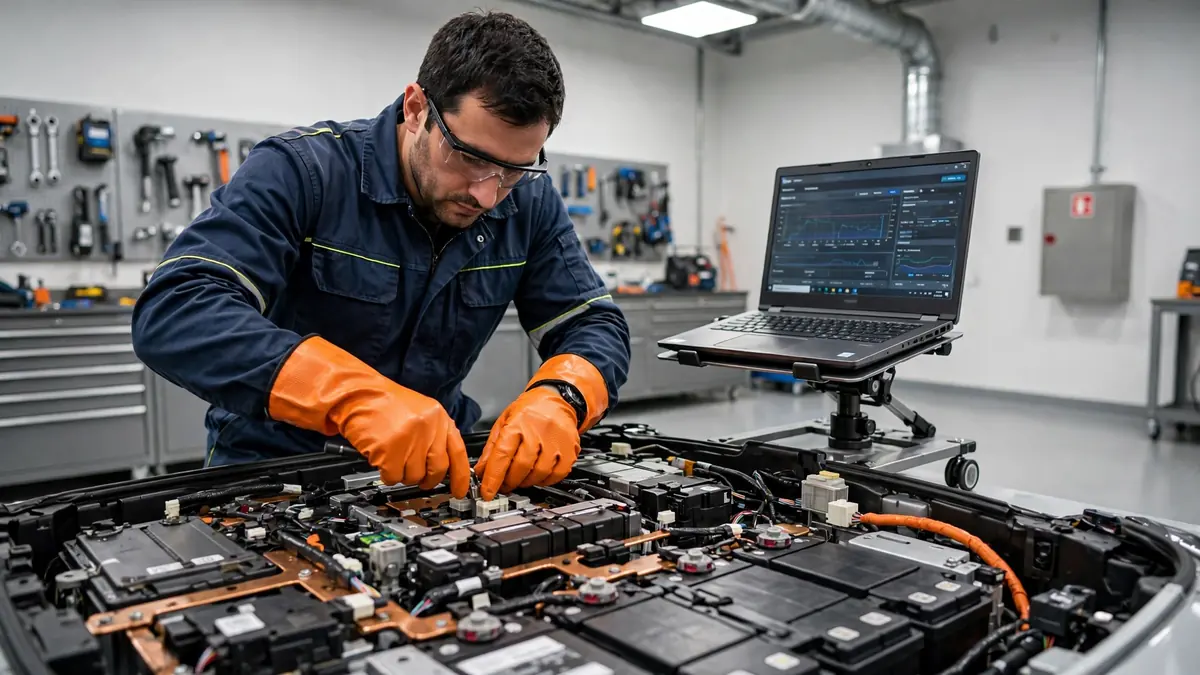
Finding a mechanic who actually knows how to work on EVs is harder than it sounds. Most general auto shops lack the training, tools, and software to safely diagnose or repair high-voltage battery systems. This guide shows you exactly how to find a qualified EV mechanic near you, and what to ask before you hand over the keys.
This guide belongs to our general guides section. For the full overview, see Common EV Battery Problems and How to Fix Them.
Quick Answer
The fastest way to find a qualified EV mechanic is to start with your car’s authorized dealer network, then check for ASE L3-certified EV technicians at independent shops. Use manufacturer service locators, the ASE shop locator at ase.com, and Rivian/Tesla’s own service networks. Always ask whether the shop has EV-specific diagnostic tools for your brand before scheduling.
Why Finding the Right EV Mechanic Matters
EV battery repairs are not like changing oil or replacing brake pads. High-voltage systems carry 400–800 volts, enough to be lethal with a single mistake. Beyond safety, diagnosing EV battery problems requires brand-specific software tools that a generic OBD2 scanner can’t access. A shop without the right tools can’t read cell-level data, test contactors, or verify isolation resistance. They’ll be guessing, and you’ll pay for it.
Option 1: Start With the Authorized Dealer
For any car still under the 8-year/100,000-mile manufacturer battery warranty, the authorized dealer is your first stop, and the only one that can perform warranty repairs. Authorized dealers have manufacturer-specific diagnostic software and factory-trained EV technicians.
How to find your brand’s nearest service center:
- Tesla: tesla.com/findus/list/services, Tesla-owned service centers only, no third-party dealers
- Ford: ford.com/dealer-locator, search for Ford-certified EV dealers
- Hyundai: hyundaiusa.com/dealer-locator
- Kia: kia.com/us/en/dealerships
- Chevy: chevrolet.com/dealer-locator
- Nissan: nissanusa.com/dealer-locator
- Rivian: rivian.com/service, Rivian service centers plus mobile service
- VW: vw.com/en/models/id-4/dealer-locator
- BMW: bmwusa.com/dealer-locator, look for i-series certified dealers
- Mercedes: mbusa.com/en/dealer-locator
- Audi: audiusa.com/dealer-locator, Audi e-tron certified dealers
- Polestar: polestar.com/find-space, Polestar Spaces (often inside Volvo dealers)
Option 2: Find an ASE-Certified EV Technician
The National Institute for Automotive Service Excellence (ASE) offers an L3 certification specifically for light duty hybrid and electric vehicle systems. Technicians who hold the ASE L3 certification have passed a standardized exam on high-voltage safety, battery diagnosis, and EV system repair.
To find ASE-certified shops near you:
- Go to ase.com
- Click “Find a Shop”
- Enter your zip code
- Filter by “Hybrid/Electric” certification
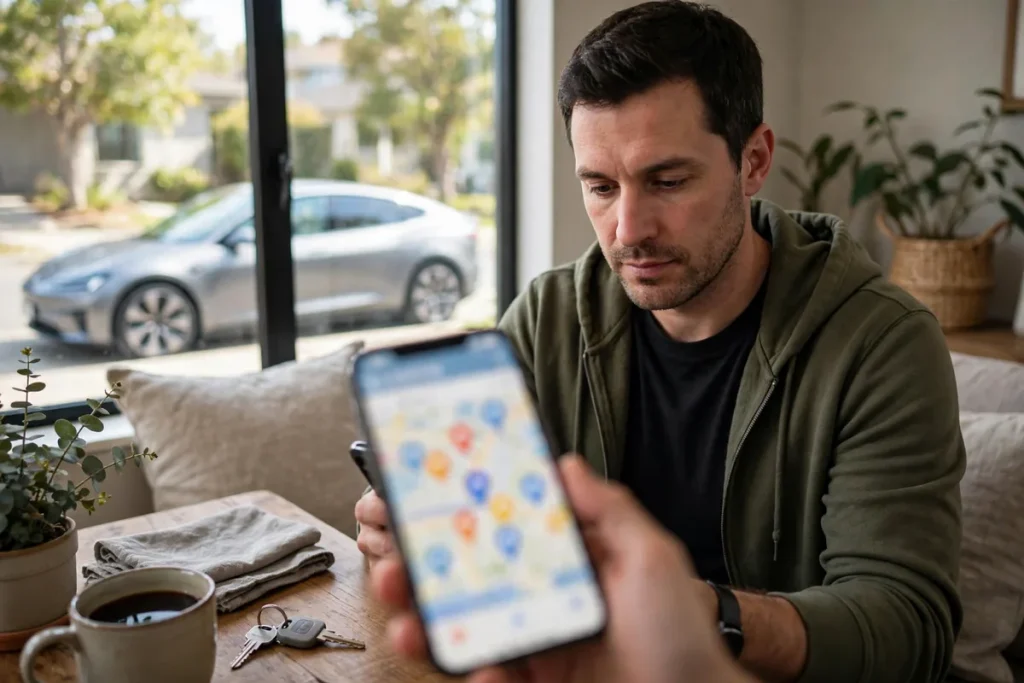
According to my experience, ASE certification tells you the technician passed the test, it doesn’t guarantee they have your specific brand’s diagnostic software. Always call ahead and ask whether they have tools for your exact make and model.
Option 3: Brand-Specific Independent Shops
Some independent shops specialize in specific EV brands and have invested in brand-specific tools. These are often former dealer technicians who started their own shops. They can do out-of-warranty repairs at lower cost than dealers.
How to find them:
- Search “[your EV brand] independent repair shop [your city]”
- Check brand-specific owner forums, Tesla forums, Bolt EV Forum, Nissan Leaf Forum, Ioniq 5 forums. Active owners often maintain lists of trusted local shops.
- Ask in local EV owner Facebook groups or Reddit communities (r/electricvehicles, r/TeslaMotors, r/BoltEV, etc.)
Option 4: Mobile EV Service
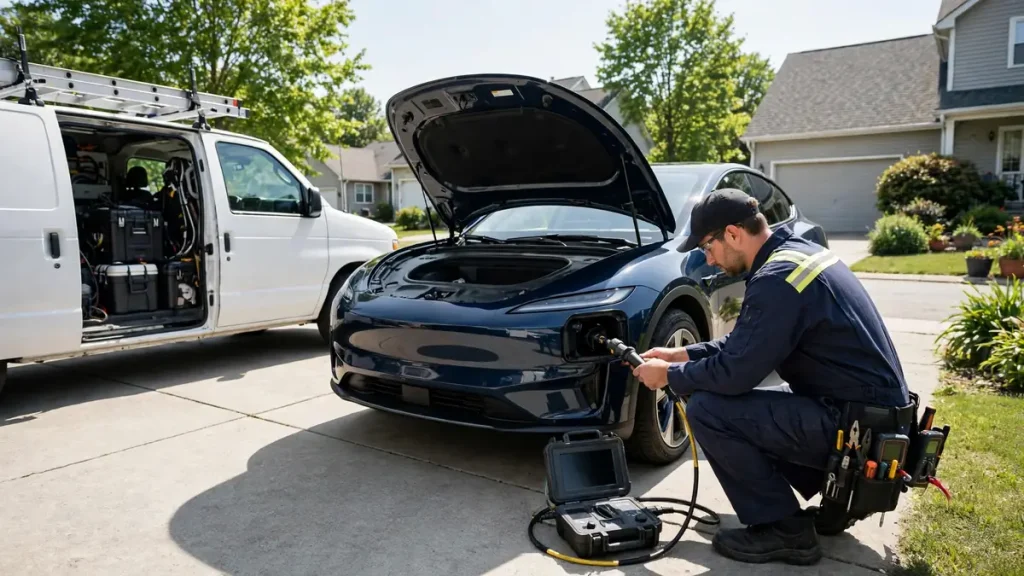
Several brands, including Tesla and Rivian, offer mobile service where a technician comes to your home or office. Mobile service can handle a wide range of repairs including software updates, 12V battery replacement, minor sensor replacements, and diagnostic scans. It’s often faster than scheduling a shop visit and costs the same.
For a related problem, see EV Battery Problems You Should Never Ignore.
- Tesla: Request mobile service through the Tesla app, available in most metro areas
- Rivian: Rivian mobile service is expanding; check availability in the Rivian app
- Hyundai/Kia: Some dealers offer mobile service for minor repairs
Questions to Ask Before Booking
Before you schedule any EV battery repair, ask these questions over the phone:
- “Do you have technicians with ASE L3 or manufacturer EV certification?”
- “Do you have the diagnostic software for [my car’s brand and model]?”
- “Have you worked on [my specific model] before?”
- “Can you check whether my battery issue is covered under the 8-year/100,000-mile warranty before I come in?”
- “Will you provide a written diagnostic report including fault codes and battery SOH?”
- “If the repair is under warranty, will you handle the claim with the manufacturer?”
Red Flags to Avoid
- A shop that says they can “fix any EV” but can’t name the diagnostic software they use
- Any shop recommending a full battery replacement without showing cell-level testing data
- A mechanic who isn’t familiar with high-voltage safety procedures (insulated gloves, lockout/tagout protocol)
- A shop that wants to open the high-voltage battery pack without proper training documentation
- Any shop that dismisses your warranty eligibility without checking the VIN against the manufacturer’s records
For Out-of-Warranty Repairs: Get Multiple Quotes
If your EV is out of warranty and facing a large battery repair, get at least two quotes, one from the dealer and one from an ASE-certified independent shop. Battery module replacements in particular can vary noticeably in price between dealers and independent shops. Third-party refurbished modules are also available for some models (Nissan Leaf, Chevy Bolt) at a fraction of dealer prices, but verify the warranty on any refurbished part.
FAQs
Can a regular mechanic work on an EV battery?
Not safely, for anything involving the high-voltage system. A regular mechanic can replace a 12V battery, check tire pressure, and handle basic brake work on an EV. But the main battery pack, contactors, onboard charger, and BMS require EV-specific training and tools. Don’t let an untrained mechanic near the high-voltage components.
Is it safe to use an independent shop for EV battery work?
Yes, if they have proper EV training and tools. For out-of-warranty repairs, a qualified independent shop can save you 20–40% compared to dealer prices. The key is verifying their credentials, ASE L3 certification, brand-specific tooling, and documented experience with your model.
What if there’s no EV dealer in my area?
For brands with limited dealer networks, Rivian, Polestar, Tesla, mobile service is often available. For others, you may need to transport the car to the nearest authorized service center. If the car is under warranty and can’t be driven safely, the manufacturer’s roadside assistance will arrange towing at no cost.
Conclusion
Finding a qualified EV mechanic starts with your brand’s authorized dealer for anything under warranty. For out-of-warranty work, ASE L3-certified independent shops can do equivalent work at lower cost. Always call ahead to verify they have your brand’s diagnostic software, ask for a written report, and never let an untrained mechanic work on your high-voltage battery system. The right shop makes a major difference, the wrong one can void your warranty or create new problems.