
How to Tell If Your EV Needs a Battery Module Replacement

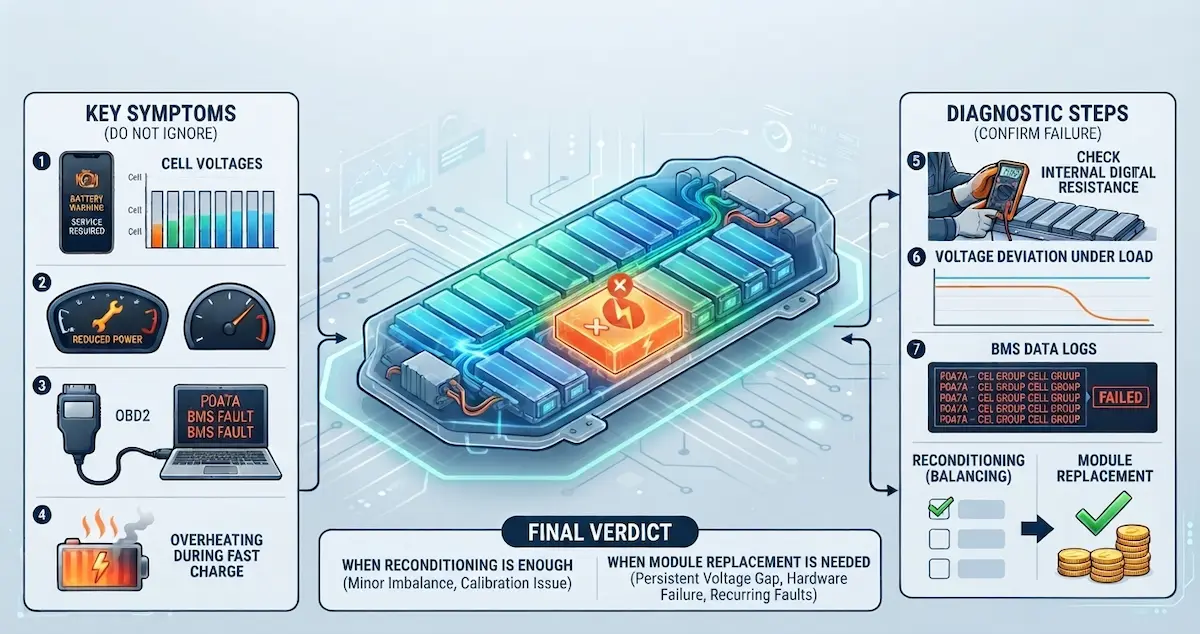
A weak EV battery does not always mean the entire battery pack needs to be replaced. Sometimes, only one battery module has failed while the rest of the pack remains healthy.
You’re wondering whether your EV’s battery problem needs a module replacement, rather than reconditioning or BMS recalibration. Because module replacement can cost thousands of dollars, it is important to know when replacement is actually necessary.
This guide explains the main signs to help you determine whether your EV needs a battery module replacement, when reconditioning may be enough, and which diagnostic tests can confirm the problem.
Quick Answer
Your EV may need a battery module replacement if one or more cell groups show a large, persistent voltage difference relative to the rest of the pack, especially when the difference persists after proper BMS balancing and recalibration.
Other important signs include repeated cell-voltage fault codes, excessive voltage drop from one cell group under load, reduced power delivery, unusual charging limits, and battery warnings that appear much earlier than expected.
A single fault code or moderate voltage imbalance does not automatically mean a module has failed. The problem should be confirmed with proper diagnostic testing before replacing an expensive battery component.
Signs That Point to Module Replacement
1. Large Cell Voltage Deviation at Mid-Range SOC
One of the most useful signs is a large voltage difference between cell groups when the battery is at a moderate state of charge.
At around 50% SOC, a healthy battery pack should generally have relatively small differences between cell groups. A much larger difference can indicate that one group has lower capacity or higher internal resistance than the others.
For example, if one cell group repeatedly sits significantly below the pack average after the battery has rested, it deserves further investigation.
A large voltage difference does not automatically prove that a module has failed. Temperature, BMS calibration, state-of-charge estimation, and measurement conditions can also affect the reading.
The important point is consistency.
If the same cell group repeatedly shows a much lower voltage under controlled conditions, the likelihood of a hardware problem increases significantly.
2. Voltage deviation worsens under load
Another strong warning sign appears when the battery is under load.
A weak module may look acceptable when the vehicle is sitting still, but its voltage can drop much faster than that of the other modules when the vehicle needs more power.
You may notice the difference during:
- Hard acceleration
- Highway driving
- Steep climbs
- High-power electrical loads
- DC fast charging
A diagnostic scanner that can display individual cell-group voltages can help identify the problem.
For example, imagine most cell groups remain close together while one group drops much lower during acceleration. If the same group repeatedly shows excessive voltage sag, it may have higher internal resistance or reduced usable capacity.
That is more concerning than a small voltage difference that disappears after balancing.
3. The Same BMS Fault Keeps Returning
The Battery Management System monitors individual cell groups and detects abnormal voltages, temperatures, and other conditions.
A fault code that appears once does not always mean the battery module has failed. Temporary conditions can trigger a warning.
However, the situation becomes more serious when:
- The same fault appears repeatedly.
- The same cell group is identified each time.
- The fault remains after clearing the code.
- The problem returns during normal driving.
- Diagnostic data supports the fault.
A recurring fault, combined with abnormal cell voltage readings, provides much stronger evidence of a hardware problem.
The exact diagnostic codes vary by vehicle make and model, so you should not assume that one code means the same thing on every EV.
4. Recalibration Does Not Correct the Problem
Sometimes a battery appears unhealthy because the BMS provides an inaccurate estimate of its state of charge.
A proper BMS recalibration or balancing procedure may improve the readings when the problem is related to calibration or cell imbalance.
However, if the same cell group continues to show a large voltage difference after appropriate diagnostic procedures, the problem may be physical rather than software-related.
This is where reconditioning may also be considered.
Reconditioning can sometimes help with certain battery problems, but it cannot restore a physically damaged or severely degraded cell to its original condition.
5. BMS Restrictions Start Affecting Daily Driving
A failing battery module can cause the BMS to protect the battery pack.
Depending on the vehicle and the type of fault, you may notice changes such as:
- Battery warnings appearing earlier than normal
- Reduced available driving power
- Reduced regenerative braking
- Unexpected charging limitations
- Lower usable battery capacity
- A sudden drop in estimated range
- Power restrictions during acceleration
These symptoms are important because they show that the problem is affecting vehicle usability, not just a diagnostic reading.
However, BMS restrictions can have many causes. Extreme temperatures, low state of charge, battery overheating, and other faults can also reduce power.
For that reason, these symptoms should be considered together with cell voltage and diagnostic data.
6. An OEM Diagnostic Test Confirms the Problem
A professional EV technician can perform tests that are not available through a basic OBD2 scanner.
Depending on the vehicle, diagnostic equipment may provide information about:
- Individual cell-group voltage
- Battery temperature
- Internal resistance
- Voltage deviation under load
- State of health
- State of charge
- Stored BMS fault codes
- Charging and power limitations
A professional diagnostic test is especially important before spending thousands of dollars on a replacement.
If the dealer confirms that one module has a serious hardware fault while the rest of the pack remains healthy, replacing that module may make more financial sense than replacing the entire battery pack.
Signs That Do Not Necessarily Mean Module Replacement
Not every battery problem requires a new module.
Some symptoms can result from normal battery aging, temperature fluctuations, calibration issues, or temporary conditions.
For example:
- Moderate cell voltage differences: The spread may narrow after proper balancing or recalibration.
- Low overall SOH: General battery degradation does not necessarily indicate that a module has failed.
- Cold-weather warnings: Battery performance can temporarily decrease at low temperatures.
- Gradual range loss: Normal battery aging causes usable capacity to decline over time.
- One-time fault codes: A single code may be caused by a temporary condition.
- Short-term charging problems: Charging equipment, temperature, or software can sometimes cause charging restrictions.
The key difference is whether the problem is persistent and repeatable.
A module should not be replaced simply because an OBD2 scanner displays one unusual number.
How Technicians Confirm a Bad Battery Module
A proper diagnosis usually involves more than checking the battery once.
A technician may compare cell groups across different states of charge and operating conditions.
The process can include:
1. Checking the Battery at Rest
The technician checks individual cell-group voltages after the vehicle has been sitting long enough for the readings to stabilize.
The goal is to determine whether one group consistently sits noticeably lower or higher than the others.
2. Checking Voltage Under Load
The technician then observes how the cell groups behave as the battery delivers power.
A weak group may show a much larger voltage drop than the rest of the pack.
3. Checking the Battery During Charging
Cell behavior can also be monitored while the vehicle charges.
A weak group may behave differently from the others as the battery approaches a higher state of charge.
5. Reviewing BMS Data
The technician checks stored fault codes and live BMS information.
The most useful diagnosis happens when the fault code and live battery data point to the same cell group.
6. Comparing Results Over Time
A single diagnostic session can sometimes be misleading.
Repeated results provide stronger evidence. If the same cell group continues to show abnormal behavior across multiple tests, the likelihood of a genuine hardware problem increases.
Module Replacement vs. Reconditioning
The choice between reconditioning and module replacement depends on the actual cause of the battery problem.
|
Situation |
More Appropriate Approach |
|---|---|
|
Minor cell imbalance |
BMS balancing or recalibration |
|
Temporary voltage difference |
Monitor and retest |
|
Calibration problem |
BMS recalibration |
|
Moderate degradation |
Reconditioning may help in some cases |
|
Persistent abnormal cell group |
Module diagnosis |
|
Confirmed hardware failure |
Module replacement |
|
Multiple severely degraded modules |
Consider full-pack economics |
Reconditioning should not be treated as a guaranteed alternative to replacement.
If a cell has lost significant capacity or developed unusually high internal resistance, reconditioning may not restore the module to reliable performance.
How Long Does a Battery Module Replacement Take?
The repair time depends on the vehicle, battery design, repair shop, and availability of replacement parts.
A dealer or qualified EV repair facility may need to:
- Diagnose the battery fault.
- Make the high-voltage system safe.
- Remove or access the battery pack.
- Replace the damaged module.
- Reassemble the battery.
- Check the high-voltage system.
- Perform required BMS procedures.
- Test the vehicle after repair.
Some repairs can be completed relatively quickly, while others may take several days.
Parts availability can also create delays, especially for older or less common EV models.
Ask the repair facility whether the replacement module is already available before scheduling the repair.
Module Replacement: Warranty vs. Out-of-Pocket
The cost of replacing an EV battery module varies widely depending on the vehicle, battery design, labor rates, and parts availability.
|
Scenario |
Possible Coverage |
Typical Cost |
|---|---|---|
|
Confirmed hardware fault during battery warranty |
Manufacturer warranty |
$0 in covered cases |
|
Module fault during basic vehicle warranty |
Vehicle warranty |
$0 in covered cases |
|
Out of warranty, dealer replacement |
No warranty coverage |
$3,000–$10,000+ |
|
Out of warranty, independent EV shop |
Shop warranty may apply |
$1,500–$5,000 |
|
Individual cell-level repair |
Depends on shop and vehicle |
$500–$2,000 |
These figures are general estimates, not guaranteed prices.
EV warranties also vary by manufacturer, model, model year, country, and warranty terms. Some warranties cover battery defects, while degradation may have different coverage rules.
Always check your vehicle’s specific warranty before approving a paid repair.
Bottom Line
An EV does not automatically require a battery module replacement due to a warning light, reduced range, or a single unusual cell voltage reading.
The strongest evidence comes from a persistent abnormal cell group, repeated BMS faults, excessive voltage sag under load, and diagnostic tests that confirm a hardware problem.
Start with proper diagnosis before replacing an expensive component. If recalibration or balancing does not correct the problem and the same cell group continues to perform poorly, module replacement may be the right solution.
If your vehicle is still covered by its battery warranty, check the warranty terms before paying for repairs. Provide the technician with as much diagnostic information as possible, including fault codes and affected cell-group data.
FAQs
How do I know if my EV battery module is bad?
Look for a persistent voltage difference between one cell group and the rest of the battery, especially when it worsens under load. Repeated BMS faults pointing to the same cell group provide additional evidence.
A professional diagnostic test is the safest way to confirm module failure.
Can battery balancing fix a bad module?
Battery balancing can help when cells have become unevenly charged.
However, balancing cannot repair a physically damaged or severely degraded cell.
If one cell group continues to perform poorly after appropriate balancing and testing, module replacement may be necessary.
Should I keep driving with a bad battery module?
It depends on the vehicle and the severity of the fault.
A minor battery imbalance may not immediately prevent normal driving. A serious BMS fault, severe power restriction, battery warning, overheating, or other high-voltage warning should be taken seriously.
If the vehicle enters a reduced-power mode or shows a serious battery warning, have it inspected by a qualified EV technician rather than continuing to drive normally.