Why Does My EV Range Drop in Cold Weather?

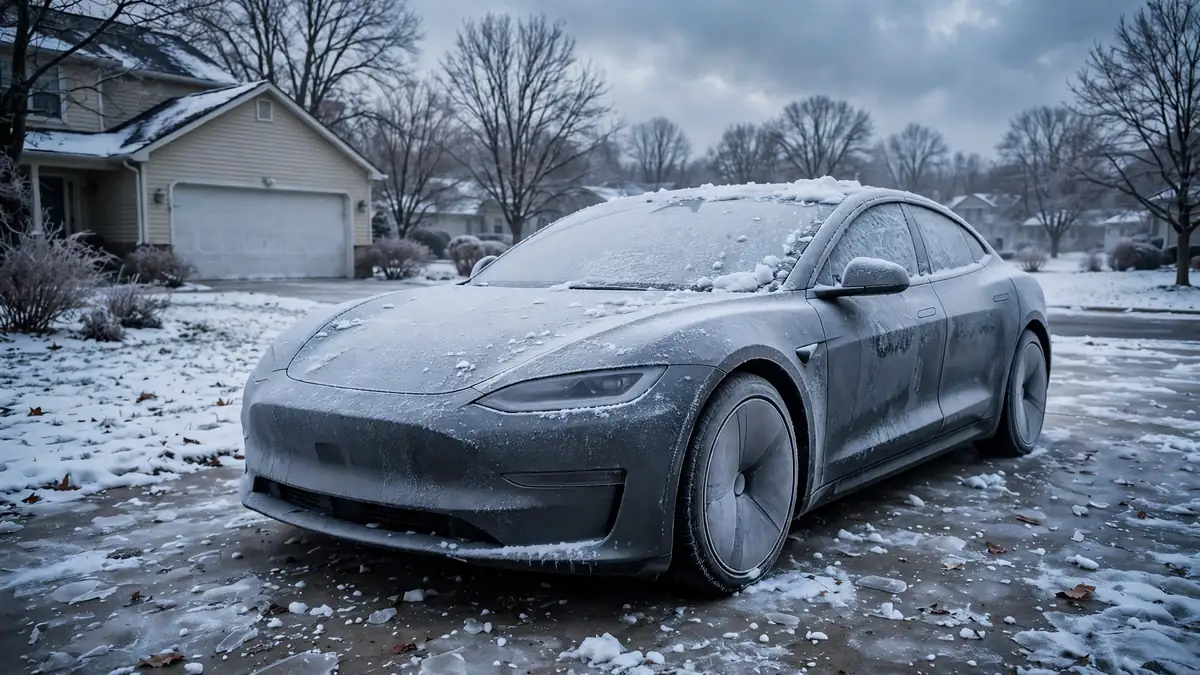
It’s winter. Your EV showed 280 miles of range in October. Now it’s showing 190. You haven’t changed anything about how you drive or charge. This guide explains exactly why EV range drops in cold weather, how much to expect, and what you can do to get it back.
This guide belongs to our EV range problems section. For the full overview, see EV Range in Sport vs Eco Mode.
The Answer in Brief
Cold weather reduces EV range because lithium-ion cells deliver less power when cold, cabin heating draws significant energy, and battery thermal management uses additional power. Range drops of 20–40% in freezing temperatures are normal for all EVs. This is not a defect and causes no permanent damage. The range returns when temperatures rise.
Why Cold Weather Hurts EV Range So Much
Reason 1: Cold cells deliver less power
Lithium-ion electrochemistry slows down at low temperatures. At 32°F, internal resistance in the cells increases and the BMS limits how much power the pack can deliver and accept. At 14°F (-10°C), some cells can temporarily lose 20–30% of their usable capacity, not permanently, just until they warm up. As the battery warms during driving, this capacity gradually returns.
Reason 2: Cabin heating is energy-intensive
Gas cars use waste engine heat to warm the cabin for free. EVs have to generate that heat electrically. A resistive heater, the type used in older EVs and some current models, draws 3–7 kW to heat the cabin. Running full heat for one hour can consume the equivalent of 10–20 miles of range. This is one of the biggest factors in cold-weather range loss.
EVs with heat pumps, including Tesla Model 3/Y (2021+), Hyundai Ioniq 5, Kia EV6, VW ID.4, Rivian R1T/R1S, and BMW i4, are noticeably more efficient at heating because heat pumps move warmth rather than generate it. They can deliver 2–3x more heating for the same energy, substantially reducing cold-weather range loss.
Reason 3: Battery thermal management uses energy
To bring the battery to its optimal operating temperature, the thermal management system has to heat the pack itself. This uses stored energy, especially in the first 10–15 minutes of a cold-weather drive before the pack reaches normal temperature. Once the battery is at temperature, this draw reduces noticeably.
Reason 4: Regenerative braking is limited when cold
Cold batteries can’t accept charge as rapidly as warm ones. The BMS reduces regenerative braking intensity when the battery is cold to prevent cell damage from high current input. This means you get less energy back from deceleration, and your effective range decreases further because you’re not recapturing as much energy.
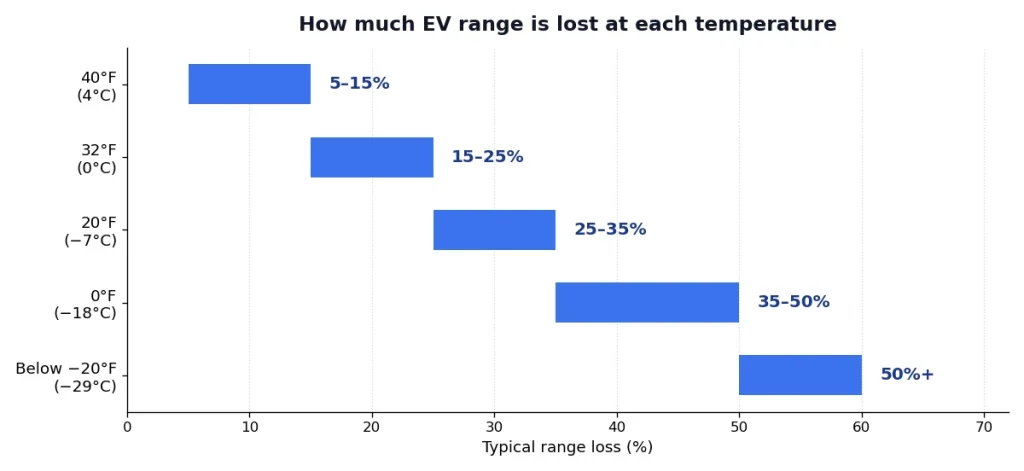
How Much Range Loss Is Normal in Cold Weather?
| Temperature | Typical Range Loss | Notes |
|---|---|---|
| 40°F (4°C) | 5–15% | Mild impact, mainly from heating |
| 32°F (0°C) | 15–25% | Cells starting to slow, heating demand high |
| 20°F (-7°C) | 25–35% | Significant, plan trips accordingly |
| 0°F (-18°C) | 35–50% | Severe, some EVs need preconditioned before driving |
| Below -20°F (-29°C) | 50%+ | Car may limit performance to protect cells |
These are averages. EVs with heat pumps and active thermal management perform better than those without. The Nissan Leaf (older models without active thermal management) loses more range in cold than most other EVs.
How to Maximize Range in Cold Weather
Tip 1: Precondition the battery while plugged in
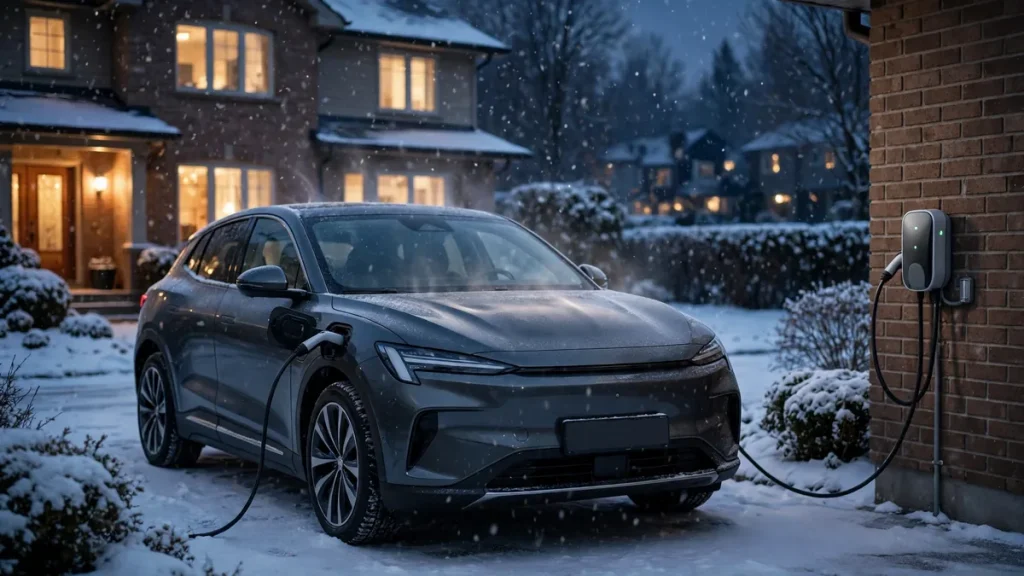
This is the single most effective cold-weather range tip. Use your car’s companion app to start cabin heating and battery preconditioning 15–20 minutes before you leave, while the car is still plugged in. The car uses grid power to warm both the cabin and the battery, so none of that energy comes from the battery. You leave with a warm car, a warm battery, and full range.
All major EVs support this: Tesla (Climate → Remote Start), Hyundai Ioniq 5 (Bluelink app), Kia EV6 (Kia Connect app), Ford Mach-E/Lightning (FordPass), Rivian (Rivian app), VW ID.4 (myVW app), BMW i4 (My BMW app), Chevy Bolt (myChevrolet app).
Tip 2: Use seat heaters and steering wheel heaters instead of cabin heat
Seat heaters and heated steering wheels draw 50–200 watts each. The cabin heater draws 3,000–7,000 watts. Heating your body directly with seat heaters uses a fraction of the energy of heating the whole cabin. Set the cabin temperature lower (62–65°F) and rely on seat heaters for personal warmth, you’ll recover 10–20 miles of range on a cold day.
Tip 3: Park in a garage
Even an unheated garage is 15–20°F warmer than outside in winter. A warmer starting battery temperature means less energy spent warming up and more range available immediately. If you have a garage, use it.
Tip 4: Reduce highway speed slightly
Air resistance increases dramatically with speed. In cold weather when range is already reduced, dropping from 75 mph to 65 mph on the highway can recover 15–20% of range. If you’re making a long trip in cold weather, slower speeds matter more in winter than in summer.
Tip 5: Keep the battery charged higher in winter
In summer, 80% daily charge is ideal. In winter, consider charging to 85–90% daily to give yourself buffer for the cold-weather range reduction. The extra degradation from occasionally charging higher in winter is negligible compared to the risk of running short in cold conditions.
Tip 6: Use Eco mode
Eco mode reduces peak power output and often adjusts HVAC behavior to prioritize efficiency over comfort. In cold weather, the energy savings from Eco mode can add 10–15% more range on an already-reduced winter battery.
Does Cold Weather Permanently Damage EV Batteries?
No, normal cold weather does not cause permanent battery damage. The reduced range and performance are entirely temporary. There is one exception: charging at high amperage when the battery is below 32°F can cause lithium plating on the anode, which does cause permanent capacity loss. This is exactly why the BMS automatically slows charging in cold weather, it’s protecting the cells from this specific type of damage. Trust the BMS and don’t try to force fast charging on a frozen battery.
For a related problem, see Why Does My EV Show Less Range After a Full Charge?.
Brand-Specific Cold Weather Notes
- Tesla: Models with heat pumps (Model 3/Y 2021+ and all Model S/X) handle cold noticeably better than earlier resistive-heat-only Teslas. Precondition the cabin and battery while plugged in before winter drives.
- Nissan Leaf: Without active thermal management, the Leaf loses more range in cold than almost any modern EV. Plan for 40–50% range reduction at 0°F. Always preheat while plugged in.
- Chevy Bolt: The Bolt has active thermal management but no heat pump. Expect 25–35% range reduction at freezing temperatures. Preconditioning via myChevrolet app is essential.
- Hyundai Ioniq 5 / Kia EV6: Both have heat pumps standard. Cold-weather performance is above average for the class. Still precondition before departing.
- Rivian R1T/R1S: Excellent cold-weather performance due to large pack size and active thermal management. Range reduction is proportionally smaller.
- Ford F-150 Lightning: Large pack, good cold-weather performance, but towing in cold noticeably amplifies range loss, plan charging stops accordingly.
FAQs
My EV range is half of normal in winter: is something wrong?
At temperatures below 0°F, a 50% range reduction is possible and doesn’t indicate a defect. If you’re seeing 50% range loss at 32°F or above, that’s more than expected, check whether the battery thermal management system is running normally and whether the cabin heater is set very high. If range doesn’t improve at all once the car has been driven 15 minutes and warmed up, have it scanned for BMS faults.
Will my EV be okay if I leave it outside overnight in -20°F?
It will survive, but it’s not ideal. At extreme cold, the BMS will try to protect the battery by keeping it at a minimum temperature, which draws from the stored charge. You may find the battery at a much lower percentage in the morning than when you parked it. Plugging in overnight allows the thermal system to maintain temperature without draining the pack. Always plug in during extreme cold.
Why does my range estimate go up as I drive in cold weather?
This is normal. The BMS starts conservatively low when the battery is cold. As the battery warms during driving, the cells deliver more usable capacity and the BMS updates its estimate upward. A range estimate that climbs from 150 to 190 miles in the first 15 minutes of cold-weather driving is working exactly as designed.
Conclusion
Cold-weather range loss is the most misunderstood EV behavior there is. Losing 20–40% of range in freezing temperatures is completely normal, temporary, and not a sign of battery damage. The best fixes are preconditioning while plugged in, using seat heaters instead of full cabin heat, parking in a garage, and adjusting your daily charge limit upward slightly in winter. Plan trips with the cold-weather range in mind and you’ll never be caught short.